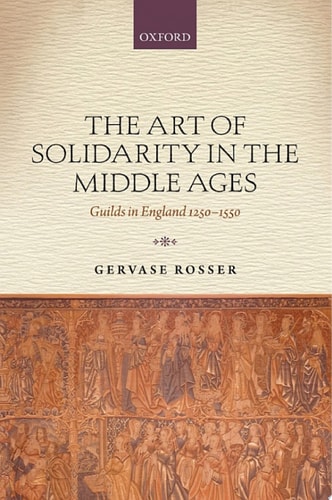
The Art of Solidarity in the Middle Ages: Guilds in England 1250-1550
0
0
As an Amazon Associate and affiliate partner, Menrva Books earns from qualifying purchases. Learn more
Author Description
Guilds and fraternities, voluntary associations of men and women, proliferated in medieval Europe. The Art of Solidarity in the Middle Ages explores the motives and experiences of the many thousands of men and women who joined together in these family-like societies. Rarely confined to a single craft, the diversity of guild membership was of its essence. Setting the English evidence in a European context, this study is not an institutional history, but instead is concerned with the material and non-material aims of the brothers and sisters of the guilds. Gervase Rosser addresses the subject of medieval guilds in the context of contemporary debates surrounding the identity and fulfilment of the individual, and the problematic question of his or her relationship to a larger society. Unlike previous studies, The Art of Solidarity in the Middle Ages does not focus on the guilds as institutions but on the social and moral processes which were catalysed by participation. These bodies founded schools, built bridges, managed almshouses, governed small towns, shaped religious ritual, and commemorated the dead, perceiving that association with a fraternity would be a potential catalyst of personal change. Participants cultivated the formation of new friendships between individuals, predicated on the understanding that human fulfilment depended upon a mutually transformative engagement with others. The peasants, artisans, and professionals who joined the guilds sought to change both their society and themselves. The study sheds light on the conception and construction of society in the Middle Ages, and suggests further that this evidence has implications for how we see ourselves.
Menrva's Summary
THE THESIS
This study investigates the social and moral motivations behind the formation of guilds and fraternities in medieval England, questioning how these associations shaped individual identity and collective societal structures. Gervase Rosser, a historian specializing in medieval social life, utilizes a broad range of English archival evidence to challenge traditional institutional interpretations of guilds. He argues that these organizations functioned primarily as vehicles for personal and communal transformation rather than mere economic or craft-based entities. By situating English guilds within a wider European framework, the author examines how participants sought to reconcile individual fulfillment with the demands of a larger, interconnected society.
THE SCOPE MAP
What You Will Find
- Analysis of guild activities including school foundation, infrastructure management, and religious ritual.
- Examination of the social and moral processes fostered by voluntary association.
- Comparative study of English guild practices against broader European historical trends.
Scope Limits
- The text does not provide a comprehensive institutional history of specific trade guilds.
- The study does not focus on the economic output or market influence of craft guilds.
THE AUTHORITY PERSPECTIVE
Scholars recognize this work as a significant departure from traditional economic histories of medieval guilds, favoring a focus on social psychology and community formation. Readers frequently note the academic density of the prose, which is intended for specialists in medieval social history and historical sociology.
Page Count:
256
Publication Date:
2015-01-01
Publisher:
OUP Oxford
ISBN-10:
0191054577
ISBN-13:
9780191054570
History
Solidarity
England
Sociology
European History
Guilds
Europe
Social History
Community Tags
Similar Books