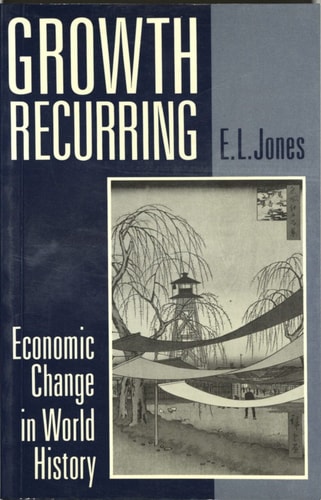
Growth Recurring: Economic Change in World History
0
0
As an Amazon Associate and affiliate partner, Menrva Books earns from qualifying purchases. Learn more
Author Description
This study concerns the conflict in world history between economic growth and political greed. E.L. Jones, author of the groundbreaking The European Miracle, proposes two fundamentally new frameworks. One replaces industrial revolution or great discontinuity as the source of change and challenges the reader to accept early periods and non-western societies as vital to understanding the growth process. It shows that growth occurred independently in Sung China and Japan as well as in Europe. The second framework offers a new explanation in which tendencies for growth were omnipresent but were usually suppressed. The "obstacles to growth" and their subsequent erosion is reviewed, providing an explanation of the modern world economy in which growth has recurred and East Asia has taken a prominent place.
Menrva's Summary
THE THESIS
This work investigates the historical tension between economic growth and political interference, challenging traditional narratives of industrialization. E. L. Jones, a noted economic historian, utilizes a comparative global framework to argue that economic growth is not a modern anomaly but a recurring phenomenon that has been historically suppressed by political structures. By examining evidence from Sung China, Japan, and Europe, the author posits that growth tendencies are omnipresent, shifting the focus from the 'industrial revolution' as a singular event to the erosion of systemic obstacles over time.
THE SCOPE MAP
What You Will Find
- Comparative analysis of economic development in Sung China, Japan, and Europe
- A framework for identifying and categorizing historical 'obstacles to growth'
- Historical evidence challenging the 'great discontinuity' theory of economic progress
- An explanation of the rise of East Asian economies within the global context
THE AUTHORITY PERSPECTIVE
Scholars and historians frequently cite this text for its departure from Eurocentric models of economic development. Readers often note the academic density of the prose, which requires a foundational understanding of economic history to fully grasp the author's arguments.
Page Count:
264
Publication Date:
1993-04-29
Publisher:
Oxford University Press
ISBN-10:
0198204043
ISBN-13:
9780198204046
History
Non-Fiction
Economics
Economics history
Economic History
World history
Community Tags
Similar Books