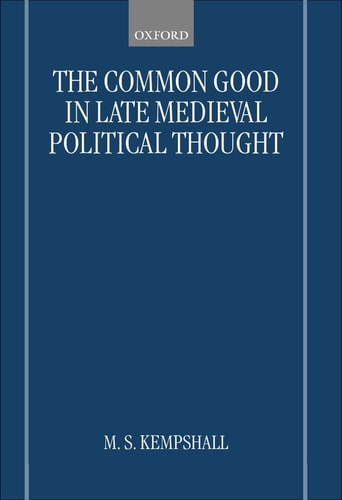
The Common Good in Late Medieval Political Thought
0
0
As an Amazon Associate and affiliate partner, Menrva Books earns from qualifying purchases. Learn more
Author Description
This book reassesses the impact of Aristotle's moral and political philosophy on medieval scholastic thought. It examines the relationship between the common good and the individual good, and between the authority of the church and the authority of the temporal ruler. The result is a major reinterpretation of the emergence of a secular theory of the state in the late thirteenth and early fourteenth centuries.
Menrva's Summary
THE THESIS
This book investigates how the integration of Aristotelian moral and political philosophy fundamentally altered medieval scholastic conceptions of the common good. M. S. Kempshall, a scholar of medieval political thought, utilizes a rigorous analysis of scholastic texts from the late thirteenth and early fourteenth centuries to trace this intellectual shift. By examining the tension between individual interests and collective welfare, the author argues that these philosophical developments provided the necessary framework for the emergence of secular state theory. The work synthesizes complex theological and political arguments to demonstrate how ancient thought was adapted to address contemporary medieval power structures.
THE SCOPE MAP
What You Will Find
- Analysis of Aristotelian moral and political philosophy in scholastic contexts
- Examination of the jurisdictional relationship between ecclesiastical and temporal authorities
- Comparative study of the individual good versus the common good
- Historical investigation into the origins of secular state theory
THE AUTHORITY PERSPECTIVE
Experts recognize this work as a dense and highly specialized contribution to the study of medieval political philosophy. Scholars frequently cite the text for its meticulous examination of scholastic sources and its nuanced reinterpretation of the transition toward secular political thought.
Page Count:
416
Publication Date:
1999-07-29
Publisher:
Clarendon Press
ISBN-10:
0198207166
ISBN-13:
9780198207160
History
Philosophy
Common Good
Political Theory
Community Tags
Other Editions(2)

Similar Books