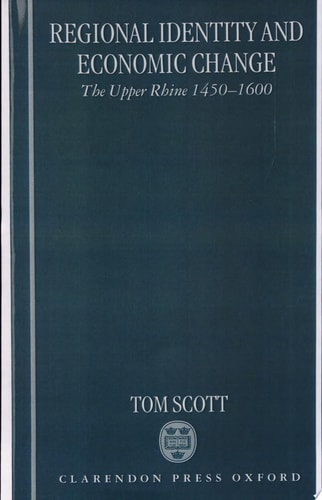
Regional Identity and Economic Change: The Upper Rhine 1450-1600
0
0
As an Amazon Associate and affiliate partner, Menrva Books earns from qualifying purchases. Learn more
Author Description
Europe lives in age of regionalism and regional identities which offer an alternative to the rigidities of organization by nation-state. Historically, such regions have been defined--if defined at all--in cultural, linguistic, ethnic, or political terms, with little emphasis on the economic factors of the period before industrialization. Tom Scott's intensive study of one region--the Upper Rhine between 1450 and 1600--redresses this imbalance. In this locality, divided between three countries and historically marginalized, Scott reveals the existence of a modern sense of regional identity working across national frontiers, and predicated on common economic interests.
Menrva's Summary
THE THESIS
This work investigates whether economic integration and shared commercial interests can foster a cohesive regional identity that transcends national borders in the pre-industrial era. Tom Scott, a specialist in German history, utilizes extensive archival research and economic data from the Upper Rhine region between 1450 and 1600 to challenge traditional definitions of regionalism. He argues that the Upper Rhine functioned as a distinct economic unit, suggesting that regional identity was driven more by trade, market access, and economic cooperation than by the cultural or linguistic markers typically emphasized by historians.
THE SCOPE MAP
What You Will Find
- Economic data and trade patterns of the Upper Rhine region from 1450 to 1600.
- Analysis of cross-border commercial networks and their impact on local governance.
- Examination of how economic interests mitigated the influence of national frontiers.
- Historical evidence regarding the transition from feudal structures to early modern regionalism.
THE AUTHORITY PERSPECTIVE
Historians recognize this text as a significant contribution to the study of early modern economic structures and regional identity. Scholars frequently cite the work for its rigorous archival methodology and its ability to reframe the Upper Rhine as a functional economic entity rather than a mere geographic periphery.
Page Count:
376
Publication Date:
1998-03-05
Publisher:
Clarendon Press
ISBN-10:
0198206445
ISBN-13:
9780198206446
History
Alsace France
Guilds
Renaissance
Cities And Towns
Germany economic conditions
European History
Economic History
Community Tags
Similar Books