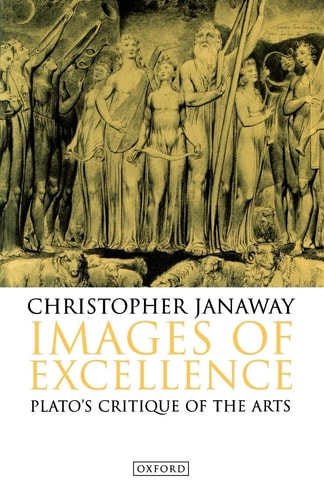
Images of Excellence: Plato's Critique of the Arts
0
0
As an Amazon Associate and affiliate partner, Menrva Books earns from qualifying purchases. Learn more
Author Description
Plato was the first great figure in Western philosophy to assess the value of the arts; he famously argued in the Republic that traditionally accepted forms of poetry, drama, and music are unsound, claiming they are conducive to warped ethical standards, detrimental to the psyche, and purveyors of illusions about important matters in human life. This view has been widely rejected; but Christopher Janaway here argues that Plato's hostile case is a more coherent and a more profound challenge to the arts than has sometimes been supposed. Denying that Plato advocates 'good art' in any modern sense, this book seeks both to understand Plato's critique in the context of his own philosophy and to locate him in today's philosophy of art, showing how issues in aesthetics arise from responses to his charges. Plato's questions about beauty, emotion, representation, ethical knowledge, artistic autonomy, and censorship are of contemporary relevance as formerly secure assumptions about the value of art and the aesthetic come under scrutiny. Images of Excellence is written not only for readers working in ancient philosophy, but for all who are interested in aesthetics, art theory, and literary theory.
Menrva's Summary
THE THESIS
This book investigates the coherence and depth of Plato's critique of the arts, challenging the common dismissal of his arguments as merely hostile or outdated. Christopher Janaway, a scholar of ancient philosophy, examines Plato's assertions within the Republic that traditional poetry, drama, and music foster unethical standards and psychological instability. By situating these claims within the broader framework of Platonic thought, the author argues that Plato presents a rigorous challenge to the value of art that remains significant for modern aesthetic discourse.
THE SCOPE MAP
What You Will Find
- An analysis of Plato's arguments regarding representation, emotion, and ethical knowledge.
- A contextual examination of the Republic's critique of poetry, drama, and music.
- A discussion on the contemporary relevance of artistic autonomy and censorship.
- A comparative study linking ancient philosophical questions to modern aesthetic theory.
THE AUTHORITY PERSPECTIVE
Scholars and students of philosophy frequently cite this work as a rigorous re-evaluation of Plato's aesthetic stance. Experts highlight the text for its ability to bridge the gap between ancient philosophical inquiry and modern debates in art theory.
Page Count:
240
Publication Date:
1998-09-03
Publisher:
Clarendon Press
ISBN-10:
0198237928
ISBN-13:
9780198237921
Philosophy
Literary theory
Aesthetics
Art Theory
Plato
Community Tags
Similar Books