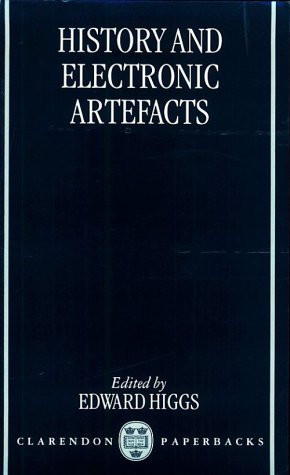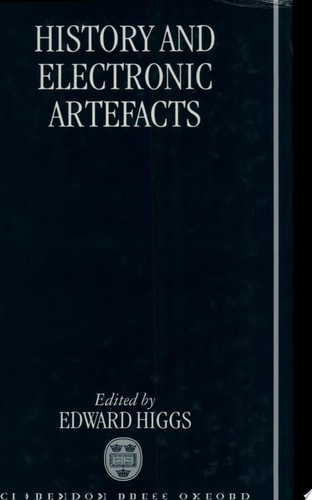
History and Electronic Artefacts
0
0
As an Amazon Associate and affiliate partner, Menrva Books earns from qualifying purchases. Learn more
Author Description
We are now entering a world of electronic communications where an increasing amount of contemporary information is created and retained only in electronic form. How will such unstable flows of information be preserved for future historians? Will the future have a past? Will the history of our contemporary world be lost to our descendants? History and Electronic Artefacts is the first publication to examine the implications of this revolution for historical research. Historians are used to handling paper and parchment record in archives. These are actual pieces of correspondence which passed between historical actors. They are also relatively stable artefacts which can be preserved easily. Two factors introduced by the electronic revolution threaten the existence of paper archives: the dissociation between information content and the media by which it is transmitted ruptures the solidity of the archival object. The ability to store electronic information anywhere and access it remotely via networks could make the central paper archive redundant. Experts from the fields of information management and technology, data archiving, library science, as well as historians, consider the issues raised in depth. The authors also place a unique emphasis on European developments.
Menrva's Summary
THE THESIS
How will the transition from physical records to unstable electronic information formats impact the ability of future historians to reconstruct the past? Edward Higgs, a scholar specializing in the history of information and technology, assembles a multidisciplinary team of experts to investigate the archival crisis posed by the digital revolution. The text argues that the shift from tangible paper and parchment to ephemeral electronic data threatens the continuity of historical record-keeping. By analyzing the technical and institutional challenges of digital preservation, the authors provide a framework for understanding how the loss of physical archival objects alters the nature of historical research.
THE SCOPE MAP
What You Will Find
- Analysis of the dissociation between information content and physical storage media.
- Examination of the impact of remote network access on traditional central archives.
- Case studies and perspectives from information management, library science, and data archiving experts.
- A specific focus on the evolution of European archival practices and digital infrastructure.
THE AUTHORITY PERSPECTIVE
Experts recognize this work as a foundational text for understanding the intersection of digital technology and historical methodology. Readers frequently note the academic density of the prose, which serves as a critical resource for archivists and historians navigating the transition to electronic record-keeping.
Page Count:
368
Publication Date:
1998-05-14
Publisher:
Oxford University Press
ISBN-10:
0198236336
ISBN-13:
9780198236337
History
Technology
History
Information Science
Documents
Archives