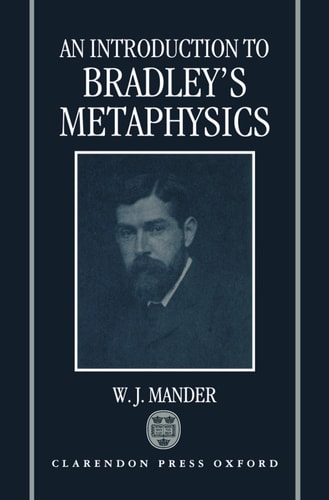
An Introduction to Bradley's Metaphysics
0
0
As an Amazon Associate and affiliate partner, Menrva Books earns from qualifying purchases. Learn more
Author Description
F. H. Bradley was the greatest of the British Idealists, but for much of this century his views have been neglected, primarily as a result of the severe criticism to which they were subjected by Russell and Moore. In recent years, however, there has been a resurgence of interest in and a widespread reappraisal of his work. W. J. Mander offers a general introduction to Bradley's metaphysics and its logical foundations, and shows that much of his philosophy has been seriously misunderstood. Dr Mander argues that any adequate treatment of Bradley's thought must take full account of his unique dual inheritance from the traditions of British empiricism and Hegelian rationalism. The scholarship of recent years is assessed, and new interpretations are offered of Bradley's views about truth, predication, and relations, and of his arguments for idealism. This book is a clear and helpful guide for those new to this difficult but fascinating thinker, and at the same time an original and stimulating contribution to the re-evaluation of his work.
Menrva's Summary
THE THESIS
This book investigates the core metaphysical framework of F. H. Bradley, seeking to resolve long-standing misunderstandings regarding his philosophical contributions. W. J. Mander, a scholar of British Idealism, utilizes a historical and analytical approach to re-examine Bradley's work in light of modern reappraisals. By synthesizing the influences of British empiricism and Hegelian rationalism, Mander constructs a defense of Bradley's logic and idealism against the historical critiques posed by Russell and Moore.
THE SCOPE MAP
What You Will Find
- Analysis of Bradley's theories on truth, predication, and relations
- Examination of the dual influence of empiricism and Hegelian rationalism
- Assessment of contemporary scholarship and recent reappraisals of Bradley's work
- Logical foundations of Bradley's arguments for idealism
THE AUTHORITY PERSPECTIVE
Experts recognize this text as a significant contribution to the re-evaluation of British Idealism. Readers frequently note the clarity of the prose, which makes complex metaphysical concepts accessible to those new to Bradley's thought.
Page Count:
192
Publication Date:
1994-05-19
Publisher:
Clarendon Press
ISBN-10:
0198240902
ISBN-13:
9780198240907
Philosophy
British Philosophy
Metaphysics
Academic
Idealism
Community Tags
Similar Books