Berkeley: An Interpretation
0
0
As an Amazon Associate and affiliate partner, Menrva Books earns from qualifying purchases. Learn more
Author Description
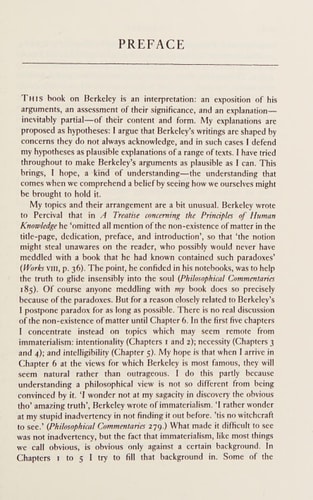
George Berkeley (1685-1753) held that matter does not exist, and that the sensations we take to be caused by an indifferent and independent world are instead caused directly by God. Nature has no existence apart from the spirits who transmit and receive it. In this book, Winkler presents these conclusions as natural (though by no means inevitable) consequences of Berkeley's reflections on such topics as representation, abstraction, necessary truth, and cause and effect. He offers new interpretations of Berkeley's views on unperceived objects, corpuscularian science, and our knowledge of God and other minds.
Menrva's Summary
THE THESIS
This work investigates the core question of how George Berkeley’s radical immaterialism functions as a coherent philosophical system rather than a series of isolated paradoxes. Kenneth P. Winkler, a scholar of early modern philosophy, utilizes a rigorous analytical framework to re-examine Berkeley’s primary texts. He argues that Berkeley’s denial of material substance is a logical extension of his reflections on abstraction, representation, and causality. By situating Berkeley within the context of his contemporaries, Winkler provides a systematic reconstruction of the philosopher's arguments regarding the nature of spirits and the external world.
THE SCOPE MAP
What You Will Find
- A detailed analysis of Berkeley’s arguments against the existence of material substance.
- An examination of Berkeley’s engagement with corpuscularian science and its implications for his idealism.
- A systematic breakdown of Berkeley’s views on abstraction and the limits of human knowledge.
- Interpretive frameworks for understanding how Berkeley accounts for the existence of other minds and the role of God in perception.
THE AUTHORITY PERSPECTIVE
Scholars frequently cite this text as a definitive, high-level interpretation of Berkeley’s metaphysical project. It is widely regarded as an essential resource for advanced students and researchers navigating the complexities of early modern empiricism.
Page Count:
336
Publication Date:
1989-05-11
Publisher:
Clarendon Press
ISBN-10:
0198249071
ISBN-13:
9780198249078
Philosophy
Metaphysics
Epistemology
Community Tags
Other Editions(3)

Similar Books