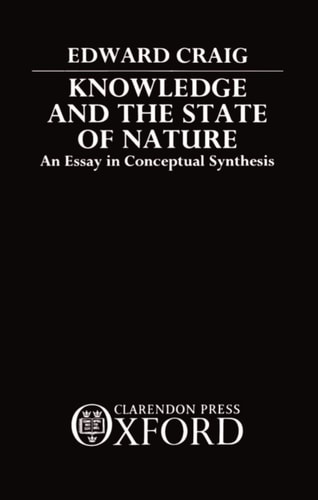
Knowledge and the State of Nature: An Essay in Conceptual Synthesis
0
0
As an Amazon Associate and affiliate partner, Menrva Books earns from qualifying purchases. Learn more
Author Description
In this illuminating study Craig argues that the standard practice of analyzing the concept of knowledge has radical defects--arbitrary restriction of the subject matter and risky theoretical presuppositions. He proposes a new approach similar to the "state-of-nature" method found in political theory, building the concept up from a hypothesis about its social function and the needs it fulfills. Shedding light on much that philosophers have written about knowledge, its analysis and the obstacles to its analysis, and the debate over skepticism, this compelling work will be of interest to students and scholars of epistemology and the philosophy of language.
Menrva's Summary
THE THESIS
This work investigates whether the traditional analytical approach to the concept of knowledge is fundamentally flawed due to its reliance on arbitrary restrictions and unexamined theoretical presuppositions. Edward Craig, a prominent philosopher, challenges the standard methodology of conceptual analysis by proposing a functionalist alternative. Drawing inspiration from the state-of-nature thought experiments common in political philosophy, he constructs a model of knowledge based on the practical social needs it serves. This framework aims to clarify long-standing debates regarding the nature of knowledge and the persistent problem of skepticism.
THE SCOPE MAP
What You Will Find
- A functionalist methodology for conceptual analysis
- A state-of-nature thought experiment applied to epistemology
- A critical evaluation of traditional analytical philosophy
- An examination of the relationship between social needs and epistemic concepts
THE AUTHORITY PERSPECTIVE
Experts in the field recognize this text as a significant contribution to contemporary epistemology, frequently citing it for its innovative approach to conceptual synthesis. Readers often note the academic density of the prose, which requires a strong background in philosophical discourse to fully appreciate the author's arguments.
Page Count:
184
Publication Date:
1991-02-28
Publisher:
Clarendon Press
ISBN-10:
0198242433
ISBN-13:
9780198242437
Philosophy
Knowledge Theory
Epistemology
Political Theory
Community Tags
Similar Books