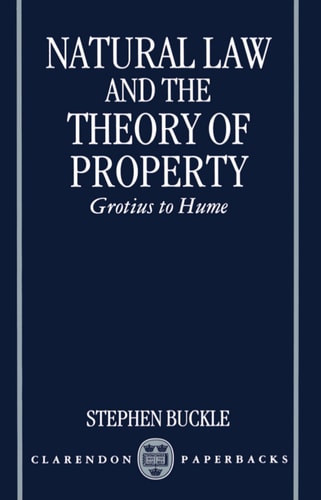
Natural Law and the Theory of Property: Grotius to Hume
0
0
As an Amazon Associate and affiliate partner, Menrva Books earns from qualifying purchases. Learn more
Author Description
In this book, Buckle provides a historical perspective on the political philosophies of Locke and Hume, arguing that there are continuities in the development of seventeenth and eighteenth-century political theory which have often gone unrecognized. He begins with a detailed exposition of Grotius's and Pufendorf's modern natural law theory, focussing on their accounts of the nature of natural law, human sociability, the development of forms of property, and the question of slavery. He then shows that Locke's political theory takes up and develops these basic themes of natural law. The author argues further that, rather than being a departure from this tradition, the moral sense theory of Hutcheson and Hume represents a not entirely successful attempt to underpin the natural law theory with an adequate moral psychology.
Menrva's Summary
THE THESIS
This book investigates the historical continuity and evolution of property theory within seventeenth and eighteenth-century political philosophy, specifically tracing the transition from natural law traditions to moral sense theory. Stephen Buckle, a scholar of political thought, utilizes a rigorous analytical framework to examine the works of Grotius, Pufendorf, Locke, Hutcheson, and Hume. By situating these thinkers within a shared intellectual lineage, he argues that the development of property rights and moral psychology is more interconnected than traditional interpretations suggest. The text provides a systematic reconstruction of how these philosophers addressed human sociability, the legitimacy of property, and the moral foundations of political authority.
THE SCOPE MAP
What You Will Find
- A detailed examination of modern natural law theory as established by Grotius and Pufendorf.
- An analysis of the development of property rights and the justification of slavery in early modern thought.
- A re-evaluation of John Locke’s political theory as a continuation of, rather than a departure from, natural law traditions.
- A critical study of Hutcheson and Hume’s moral sense theory as an attempt to provide a psychological basis for natural law.
THE AUTHORITY PERSPECTIVE
Scholars and students of political philosophy frequently cite this work for its precise mapping of the intellectual lineage between natural law and the Scottish Enlightenment. Experts highlight the text as a rigorous resource for understanding the nuances of early modern property theory and the evolution of moral psychology.
Page Count:
344
Publication Date:
1991-07-18
Publisher:
Oxford University Press
ISBN-10:
0198242395
ISBN-13:
9780198242390
Philosophy
Political Philosophy
Property
Ethics history
Natural law
Legal Theory
Community Tags
Other Editions(3)
Similar Books