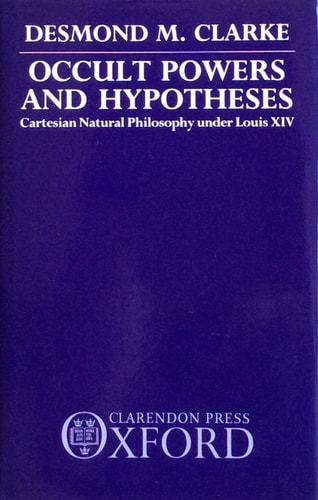
Occult Powers and Hypotheses: Cartesian Natural Philosophy Under Louis XIV
0
0
As an Amazon Associate and affiliate partner, Menrva Books earns from qualifying purchases. Learn more
Author Description
This book analyses the concept of scientific explanation developed by French disciples of Descartes in the period 1660-1700. Clarke examines the views of authors such as Malebranche and Rohault, as well as those of less well-known authors such as Cordemoy, Gadroys, Poisson and Régis. These Cartesian natural philosophers developed an understanding of scientific explanation as necessarily hypothetical, and, while they contributed little to new scientific discoveries, they made a lasting contribution to our concept of explanation--generations of scientists in subsequent centuries followed their lead.
Menrva's Summary
THE THESIS
This work investigates how French Cartesian philosophers during the late seventeenth century redefined the nature of scientific explanation by establishing it as a fundamentally hypothetical endeavor. Desmond M. Clarke, a scholar of seventeenth-century philosophy, analyzes the intellectual output of figures such as Malebranche, Rohault, Cordemoy, Gadroys, Poisson, and Régis. By examining their writings between 1660 and 1700, the author demonstrates how these thinkers shifted the focus of natural philosophy from seeking absolute certainty to constructing explanatory models. This framework provided a new conceptual foundation for scientific inquiry that persisted long after the specific Cartesian theories were superseded.
THE SCOPE MAP
What You Will Find
- An analysis of French Cartesian natural philosophy between 1660 and 1700.
- Examination of the shift toward hypothetical scientific explanation.
- Comparative study of major thinkers like Malebranche alongside lesser-known figures like Cordemoy and Régis.
- Discussion on the long-term impact of Cartesian methodology on subsequent scientific thought.
THE AUTHORITY PERSPECTIVE
Scholars recognize this text as a rigorous examination of the transition in early modern scientific methodology. Readers frequently note the academic density of the prose, which serves as a foundational resource for those studying the history of Cartesianism and the evolution of scientific explanation.
Page Count:
280
Publication Date:
1989-05-18
Publisher:
Oxford University Press
ISBN-10:
0198248121
ISBN-13:
9780198248125
Philosophy
History
Science
Cartesianism
Intellectual History
Community Tags
Similar Books