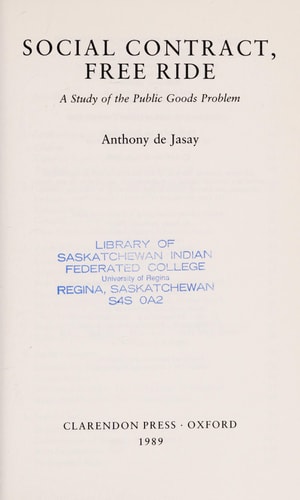
Social Contract, Free Ride: A Study of the Public Goods Problem
0
0
As an Amazon Associate and affiliate partner, Menrva Books earns from qualifying purchases. Learn more
Author Description
This book provides a novel account of the dilemma over how "public goods"--including civil order, defense, social welfare--should be provided and who should provide them. The author shows how present systems, in an attempt at fairness, actually help breed the parasitic "free riding" they were meant to suppress. He argues that, in the absence of taxation, many public goods would be provided by spontaneous group cooperation. However, this would imply some degree of free riding that would eventually lead cooperating groups away from voluntary solutions and closer to compulsory ones, bringing the problem full circle. De Jasay argues that these conflicting incentives are the principle cause of the poor functioning of organized society.
Menrva's Summary
THE THESIS
This work investigates the fundamental tension between the provision of public goods and the emergence of free-riding behavior within organized societies. Anthony de Jasay, a political philosopher and economist, utilizes game theory and classical liberal logic to challenge the conventional necessity of state-mandated taxation. He argues that the pursuit of distributive fairness often exacerbates the very parasitic behaviors it seeks to eliminate, creating a cyclical reliance on compulsory systems.
THE SCOPE MAP
What You Will Find
- Analysis of public goods including civil order, national defense, and social welfare systems.
- Application of game theory to explain individual incentives in cooperative group settings.
- Critique of state-led taxation as a mechanism for solving collective action problems.
- Exploration of spontaneous cooperation as a voluntary alternative to compulsory provision.
THE AUTHORITY PERSPECTIVE
Scholars and economists frequently cite this text for its rigorous challenge to standard public choice theory and its provocative stance on voluntary cooperation. Readers often note the high level of analytical density and the author's uncompromising logical framework regarding the limitations of state intervention.
Page Count:
264
Publication Date:
1989-02-23
Publisher:
Oxford University Press
ISBN-10:
0198244746
ISBN-13:
9780198244745
Economics
Philosophy
Public Policy
Public goods
Social Theory
Community Tags
Similar Books