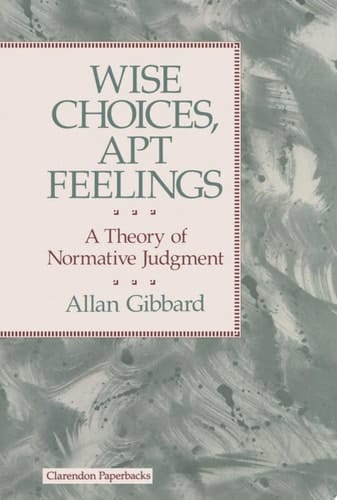
Wise Choices, Apt Feelings: A Theory of Normative Judgment
0
0
Author Description
Choices can be wise or foolish, and feelings can be apt or off the mark. So we judge, and it would be good to know what content these normative judgements carry. Gibbard offers an answer, and elaborates it. His theory explores what is at issue in narrowly moral questions, and in questions of rational thought and conduct in general.
Menrva's Summary
THE THESIS
This book investigates the semantic content and logical structure of normative judgments, specifically addressing how we determine if a choice is wise or a feeling is apt. Alan Gibbard, a distinguished philosopher, utilizes a framework rooted in expressivism to analyze the nature of moral and rational discourse. He argues that normative statements do not merely describe the world but instead express a state of mind, providing a systematic account of how these judgments function within human reasoning and social coordination.
THE SCOPE MAP
What You Will Find
- A comprehensive theory of normative judgment based on expressivist semantics.
- An analysis of the distinction between moral questions and broader questions of rational conduct.
- Philosophical arguments regarding the nature of rationality and emotional appropriateness.
- A systematic exploration of how normative language functions in human life and decision-making.
THE AUTHORITY PERSPECTIVE
Experts in metaethics recognize this work as a foundational text for understanding contemporary expressivist theory. Readers frequently note the high level of academic density and the rigorous analytical approach required to engage with Gibbard's complex arguments.
Page Count:
360
Publication Date:
1990-05-17
Publisher:
OUP Oxford
ISBN-10:
0198249853
ISBN-13:
9780198249856
Philosophy
Politics & Social Sciences
Rationality
Ethics
Metaethics
Ethics & Morality
Normative Theory
Community Tags
Similar Books