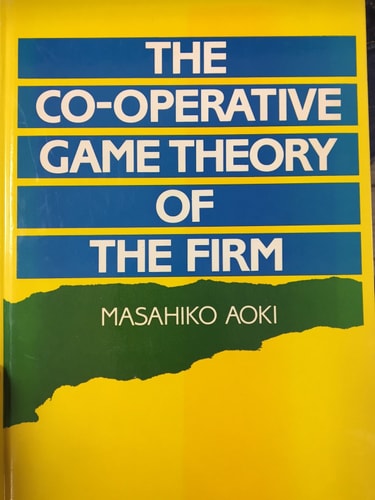
The Co-operative Game Theory of the Firm
0
0
As an Amazon Associate and affiliate partner, Menrva Books earns from qualifying purchases. Learn more
Author Description
This highly original book challenges the orthodox economic theory of the firm as a mysterious "black box" whose internal design is unknown and irrelevant and which operates solely to maximize shareholder profit. Instead, the author proposes a new "cooperative game theory," in which the firm is a coalition of shareholders and employees, with its market behavior and internal distribution the result of a cooperative game (bargaining). Aoki tests his model against existing industrial structures, including the Anglo-American unionized firm, the German/Swedish co-determination firm, and the American non-union or Japanese firm.
Menrva's Summary
THE THESIS
This book investigates whether the traditional economic model of the firm as a profit-maximizing black box can be replaced by a cooperative game theory framework that accounts for internal bargaining between stakeholders. Masahiko Aoki, a prominent economist, utilizes game theory to analyze the firm as a coalition of shareholders and employees. By moving away from the singular focus on shareholder profit, he constructs a model where market behavior and internal resource distribution emerge from the cooperative interactions of these groups. The text synthesizes organizational theory with mathematical modeling to provide a more nuanced understanding of corporate structure.
THE SCOPE MAP
What You Will Find
- A cooperative game theory model of the firm involving shareholders and employees
- Comparative analysis of industrial structures including Anglo-American, German, Swedish, and Japanese firms
- Theoretical exploration of internal bargaining and firm-level decision-making
- Empirical testing of organizational models against real-world industrial systems
THE AUTHORITY PERSPECTIVE
Experts recognize this work as a significant contribution to institutional economics and the study of corporate governance. Readers frequently note the academic density of the prose, which requires a foundational understanding of game theory and economic modeling to fully grasp the author's arguments.
Page Count:
228
Publication Date:
1984-01-01
Publisher:
Oxford University Press
ISBN-10:
0198284853
ISBN-13:
9780198284857
Business
Economics
Management
Game theory