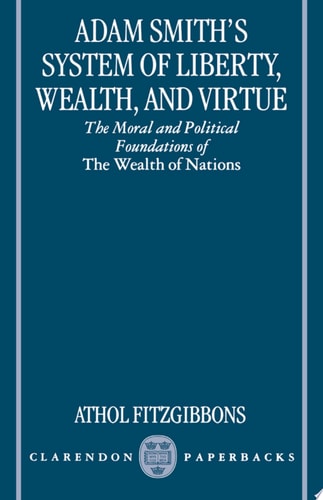
Adam Smith's System of Liberty, Wealth, and Virtue: The Moral and Political Foundations of The Wealth of Nations
0
0
As an Amazon Associate and affiliate partner, Menrva Books earns from qualifying purchases. Learn more
Author Description
Adam Smith's System of Liberty, Wealth, and Virtue analyses the influence of Smith's philosophy on his economic theories. It considers the significance of his Stoic beliefs, and examines his theories of art and science, of law and rhetoric, and of history, politics, and war. It shows how Smith based his system of thought on the heretical moral notion that virtue was relevant to this world rather than the next. Smith believed that unworldly philosophies were inherently authoritarian, because they were unable to harness the force of self-love productively. Yet, contrary to a common view, he also rejected the amoral liberalism advocated by his friend and countryman David Hume. Smith's theories of free trade, economic growth, and alienation, which constitute the substance of The Wealth of Nations, were all formally derived from his liberalized interpretation of ancient virtue. This book describes how Smith's economic theories were subsequently isolated from his philosophy and adapted to promote ends other than his own. The book will be of interest to economists, political theorists, philosophers, lawyers concerned with jurisprudence, and to all who have been intrigued by Adam Smith. It is clearly written; it puts Smith's theory of economic growth in a new light, and it reveals, for the first time, the principles that unified his world view.
Menrva's Summary
THE THESIS
This book investigates the core question of how Adam Smith’s moral and philosophical framework serves as the foundational basis for his economic theories in The Wealth of Nations. Athol Fitzgibbons, an expert in the history of economic thought, argues that Smith’s work is often misunderstood because his economic principles have been stripped of their original moral and Stoic context. By examining Smith’s broader writings on law, rhetoric, and history, the author demonstrates that Smith’s vision of liberty was deeply rooted in a secularized interpretation of ancient virtue rather than the amoral liberalism often attributed to him.
THE SCOPE MAP
What You Will Find
- An analysis of the influence of Stoic philosophy on Smith's economic framework.
- A detailed examination of Smith's theories regarding law, rhetoric, art, and science.
- A critique of how Smith's economic theories were isolated from his moral philosophy by later interpreters.
- An exploration of the tension between Smith's views and the amoral liberalism of David Hume.
THE AUTHORITY PERSPECTIVE
Scholars and economists frequently cite this work for its ability to synthesize Smith’s disparate writings into a unified intellectual system. The text is recognized for providing a nuanced perspective that challenges standard interpretations of Smith as a purely secular or amoral economic theorist.
Page Count:
224
Publication Date:
1995-08-31
Publisher:
Clarendon Press
ISBN-10:
0198289235
ISBN-13:
9780198289234
Philosophy
Economics
History
Biography
Economics
Economics history