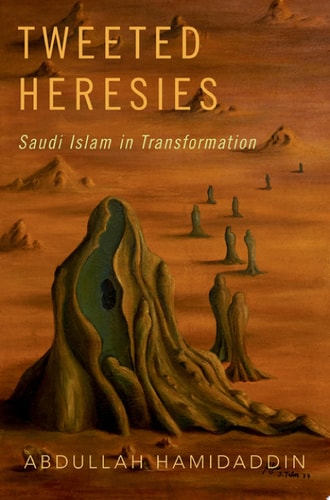
Tweeted Heresies
0
0
As an Amazon Associate and affiliate partner, Menrva Books earns from qualifying purchases. Learn more
Author Description
In Recent Years, An Internal Debate Has Arisen In Saudi Arabia On The Legitimacy Of Saudi Religion And The Foundations Of Islam. Sparked By Concerns Such As The Absence Of Divine Intervention In The Syrian Civil War, The Question Of The Muslim Monopoly On Heaven, And Politically Subversive Differentiations Between Saudi Religion And Islam, The Challenge Within Saudi Arabia To Religious Orthodoxy Has Never Been Greater. Tweeted Heresies Explores The Emergence Of These Patterns Of Non-belief And The Responses To Them From The Salafi-wahhabi Religious Institutions. Previous Studies Have Focused On Formal Institutions And Their Role In Religious Change. Abdullah Hamidaddin Focuses On Individuals Who Took Advantage Of Social Media During A Period Of Relative Freedom Of Expression To Criticize Religion And Question The Most Fundamental Aspects Of Saudi Society: Its Politics, Religion, Social Justice, Gender And Sexual Relations, And The Future Of The Country. These Individuals Mounted A Direct Challenge To Religious Orthodoxy, Whether Through Calls For Religious Reform Or, Even More Provocatively, Debates Over Concepts Of Deity, Morality, And Duty To Allah. For The Foreseeable Future Criticism Is Limited To Virtual Spaces, And The Conversation Was Especially Active On Twitter. Tweeted Heresies Examines A Large Body Of Tweets, As Well As Interviews With Saudis About How Their Understanding And Critique Of Religion Have Developed Over The Course Of Their Lives. The Result Is A Uniquely Revealing Portrait Of An Otherwise Hidden Current Of Religious Change That Promises To Ultimately Transform Saudi Society.
Menrva's Summary
THE THESIS
This book investigates the emergence of non-belief and religious criticism within Saudi Arabia, specifically examining how social media platforms facilitated challenges to traditional religious orthodoxy. Abdullah Hamidaddin, a researcher specializing in Saudi social and religious dynamics, utilizes a framework of digital sociology to analyze the shift in public discourse. He argues that the transition from institutional religious control to individual, decentralized critique on platforms like Twitter represents a significant transformation in the Saudi social and political landscape.
THE SCOPE MAP
What You Will Find
- Analysis of Twitter discourse regarding religious reform, morality, and the nature of the deity.
- Examination of the tension between Salafi-Wahhabi institutions and individual dissenters.
- Qualitative data derived from interviews with Saudi citizens regarding their evolving religious perspectives.
Scope Limits
- The analysis is primarily restricted to virtual spaces and digital interactions rather than physical, offline religious movements.
- The study focuses on a specific period of relative freedom of expression on social media and does not cover subsequent shifts in state-led digital surveillance.
THE AUTHORITY PERSPECTIVE
Experts identify this work as a significant contribution to the study of contemporary Saudi religious discourse and digital activism. Readers frequently note the academic rigor of the research, which provides a rare, granular look at private religious questioning within a traditionally conservative society.
Page Count:
304
Publication Date:
2019-01-01
Publisher:
Oxford University Press
ISBN-10:
0190062592
ISBN-13:
9780190062590
Religion
Saudi Arabia
Social Media
Islam
Sociology
Middle Eastern
Community Tags
Other Editions(2)
Similar Books