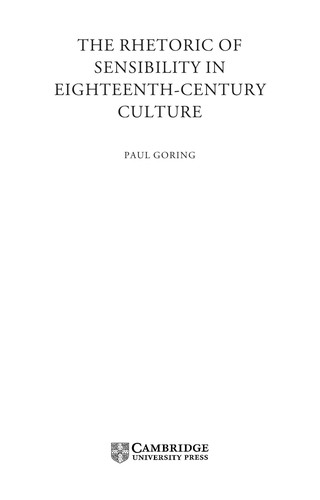
Rhetoric of Sensibility in Eighteenth-Century Culture
0
0
As an Amazon Associate and affiliate partner, Menrva Books earns from qualifying purchases. Learn more
Author Description
This book explores the burgeoning 18th-century fascination with the human body as an eloquent, expressive object. This wide-ranging study examines the role of the body within a number of cultural arenas--particularly oratory, the theatre, and the novel--and charts the efforts of projectors and reformers who sought to exploit the textual potential of the body for the public assertion of modern politeness. The author shows how diverse writers and performers, including David Garrick, James Fordyce, Samuel Richardson, Sarah Fielding and Laurence Sterne, were involved in the construction of new ideals of physical eloquence--bourgeois, sentimental ideals which stood in contrast to more patrician, classical bodily modes. Through innovative readings of fiction and contemporary manuals on acting and public speaking, Goring reveals the ways in which the human body was treated as an instrument for the display of sensibility and polite values.--Jacket.
Menrva's Summary
THE THESIS
This book investigates the 18th-century cultural shift that viewed the human body as a primary site for expressing sensibility and politeness. It examines how this fascination manifested in oratory, theatre, and the novel, detailing the efforts of reformers to utilize the body for public displays of modern manners. The study analyzes the contributions of key figures like David Garrick, James Fordyce, Samuel Richardson, Sarah Fielding, and Laurence Sterne in shaping new ideals of physical eloquence, contrasting them with older, aristocratic bodily norms. Through close readings of literary works and practical manuals, the book demonstrates how the body became an instrument for embodying and disseminating values of sensibility and politeness.
THE SCOPE MAP
- Analysis of the body as an expressive object in 18th-century culture.
- Exploration of the role of the body in oratory, theatre, and the novel.
- Examination of reformers and projectors who promoted physical eloquence.
- Discussion of new bourgeois, sentimental ideals of bodily expression.
- Contrast between new ideals and older, patrician bodily modes.
- Readings of fiction by Samuel Richardson, Sarah Fielding, and Laurence Sterne.
- Analysis of contemporary manuals on acting and public speaking.
- Focus on the construction of politeness and sensibility through bodily display.
THE AUTHORITY PERSPECTIVE
The book is recognized for its in-depth exploration of the cultural significance of the body in the 18th century, particularly its role in the development of politeness and sensibility. Scholars have noted its innovative readings of literary and performance texts, highlighting how it connects physical expression to broader social and cultural shifts. The work is appreciated for its detailed examination of key figures and their contributions to new ideals of bodily eloquence. It offers a nuanced perspective on the transition from classical to sentimental bodily modes in public and private life.
Page Count:
222
Publication Date:
2005-01-01
ISBN-10:
0521845092
History
Non-Fiction
Rhetoric
Body Studies
Cultural History
Literary Criticism
Community Tags
Similar Books