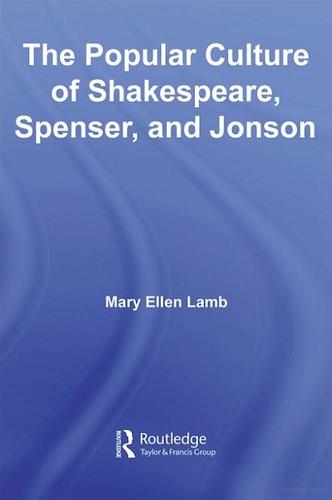
Popular Culture of Shakespeare, Spenser and Jonson
0
0
As an Amazon Associate and affiliate partner, Menrva Books earns from qualifying purchases. Learn more
Author Description
Breaking new ground by considering productions of popular culture from above, rather than from below, this book draws on theorists of cultural studies, such as Pierre Bourdieu, Roger Chartier and John Fiske to synthesize work from disparate fields and present new readings of well-known literary works. Using the literature of Shakespeare, Spenser and Jonson, Mary Ellen Lamb investigates the social narratives of several social groups: an urban, middling group; an elite at the court of James; and an aristocratic faction from the countryside. She states that under the pressure of increasing economic stratification, these social fractions created cultural identities to distinguish themselves from each other -- particularly from lower status groups. Focusing on Shakespeare's *A Midsummer Night's Dream* and *Merry Wives of Windsor*, Spenser's *Faerie Queene*, and Jonson's *Masque of Oberon*, she explores the ways in which early modern literature formed a particularly productive site of contest for deep social changes, and how these changes in turn, played a large role in shaping some of the most well-known works of the period.
Menrva's Summary
THE THESIS
This book investigates how early modern English literature, specifically the works of Shakespeare, Spenser, and Jonson, served as a site for social contest and identity formation during a period of economic stratification. Mary Ellen Lamb, drawing on cultural studies theorists, examines how distinct social groups—urban middling classes, the court elite, and the rural aristocracy—created cultural identities to differentiate themselves, particularly from lower status groups. The analysis focuses on specific works like Shakespeare's A Midsummer Night's Dream and Merry Wives of Windsor, Spenser's Faerie Queene, and Jonson's Masque of Oberon to demonstrate how these literary texts reflected and shaped deep social changes of the era.
THE SCOPE MAP
- Analysis of cultural production from an 'above' perspective, rather than 'below'.
- Application of theories from cultural studies scholars such as Pierre Bourdieu, Roger Chartier, and John Fiske.
- Synthesis of work from disparate academic fields to present new readings of literary texts.
- Examination of social narratives of specific groups: urban middling, court elite, and rural aristocracy.
- Exploration of how economic stratification influenced the creation of cultural identities.
- Focus on key literary works: Shakespeare's A Midsummer Night's Dream and Merry Wives of Windsor, Spenser's Faerie Queene, and Jonson's Masque of Oberon.
- Argument that early modern literature was a productive site for contesting and reflecting deep social changes.
THE AUTHORITY PERSPECTIVE
This book is recognized for its innovative approach to analyzing early modern literature through the lens of popular culture and social stratification. By synthesizing theories from cultural studies and applying them to canonical works, Lamb offers fresh interpretations of Shakespeare, Spenser, and Jonson. The work is noted for its detailed examination of how social groups constructed identities in response to economic pressures. Scholars appreciate its contribution to understanding the dynamic relationship between literature and the social changes of the period.
Page Count:
271
Publication Date:
2006-01-01
ISBN-10:
0415288819
ISBN-13:
9780415288811
Non-Fiction
Literary Fiction
History
Literary Criticism
Renaissance
Early Modern
Shakespearean Studies