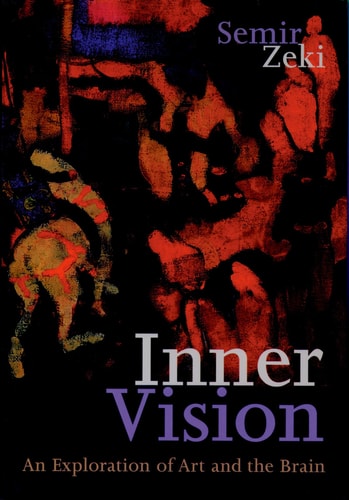
Inner Vision: An Exploration of Art and the Brain
0
0
As an Amazon Associate and affiliate partner, Menrva Books earns from qualifying purchases. Learn more
Author Description
What is it that makes a work of art appear to us as beautiful? How do external form and internal perception coalesce to create the distinctive aesthetic pleasures we look to find in the visual arts? In Inner Vision, one of the founders of visual neuroscience, Semir Zeki, offers the first attempt to apply the science of vision to painting and sculpture, revealing how the conception, execution, and appreciation of the visual arts are all shaped by the anatomy of the brain.Using a range of examples from artists including Rembrandt, Vermeer, Magritte, Mondrian, and Picasso, Zeki takes the reader on an illuminating tour of the way the brain sees, showing how its visual processing shapes art and our response to it. Vision, he writes, is designed to gather knowledge about the world around us, breaking down visual images into their basic components. He describes in fascinating detail how different areas of the brain respond to the basic visual elements, such as color, form, line, and motion, which are also basic elements of art. He further argues that all visual art is expressed through the brain and, whether the artist realizes it or not, must therefore mirror the workings of the brain. Beauty may not be in the eye of the beholder, strictly speaking, but it most certainly is in the brain of the beholder. And Zeki argues that no theory of aesthetics will be complete unless it is substantially based on the activity of the brain.Beautifully illustrated and vividly written, Inner Vision takes an important first step toward providing a scientific theory of aesthetics.
Menrva's Summary
THE THESIS
This work investigates the biological foundations of aesthetic experience by questioning how the human brain processes visual art to generate perceptions of beauty. Semir Zeki, a pioneer in visual neuroscience, utilizes his extensive research on the cerebral cortex to bridge the gap between biological function and artistic expression. He posits that the brain is not merely a passive recipient of visual stimuli but an active processor that decomposes images into fundamental components like color, form, and motion. By aligning these neurological processes with historical artistic techniques, Zeki constructs a framework for a scientific theory of aesthetics.
THE SCOPE MAP
What You Will Find
- Analysis of how the visual cortex processes fundamental elements such as line, color, and motion.
- Examination of works by masters including Rembrandt, Vermeer, Magritte, Mondrian, and Picasso.
- A neurobiological framework explaining the relationship between external visual stimuli and internal perception.
- Theoretical arguments regarding the necessity of integrating neuroscience into the study of aesthetics.
THE AUTHORITY PERSPECTIVE
Experts recognize this text as a foundational contribution to the field of neuroaesthetics, bridging the divide between the humanities and the hard sciences. Readers frequently note the clarity with which Zeki explains complex neurological functions, making the material accessible to those without a background in biology.
Page Count:
240
Publication Date:
2000-02-17
Publisher:
Oxford University Press
ISBN-10:
0198505191
ISBN-13:
9780198505198
Science
Art
Psychology
Neuroscience
Creative ability
Aesthetics
Community Tags
Similar Books