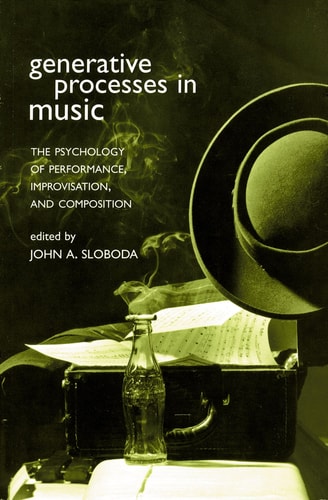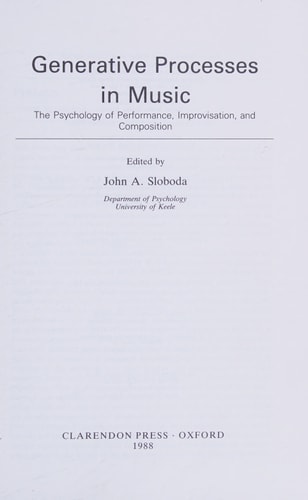
Generative Processes in Music: The Psychology of Performance, Improvisation, and Composition
0
0
As an Amazon Associate and affiliate partner, Menrva Books earns from qualifying purchases. Learn more
Author Description
This book draws together pioneering contributions to the study of the processes by which music is created. It redresses a balance in contemporary literature on the psychology of music which has, to date, concentrated mainly on receptive processes. The focus throughout is on empirical observation and the development of cognitive theory, with fascinating explorations of such topics as the generation of expression in musical performance, problems of synchrony in ensemble performance, improvisational skill in trained and untrained musicians, childrens' spontaneous notations for music, and formal constraints on compositional systems.
Menrva's Summary
THE THESIS
This volume investigates the cognitive and psychological mechanisms underlying the creation of music, specifically focusing on performance, improvisation, and composition. John A. Sloboda, a prominent researcher in the psychology of music, compiles empirical studies to shift the academic focus from music perception to the active processes of musical generation. The text provides a theoretical framework for understanding how musicians translate internal concepts into audible structures through rigorous observation and cognitive modeling.
THE SCOPE MAP
What You Will Find
- Empirical analysis of expressive performance techniques
- Cognitive models of improvisational skill across different training levels
- Examination of synchrony and coordination in ensemble performance
- Case studies on spontaneous musical notation in children
- Theoretical exploration of formal constraints within compositional systems
THE AUTHORITY PERSPECTIVE
Experts recognize this work as a foundational text for understanding the cognitive architecture of musical production. Readers frequently note the academic density of the prose, which serves as a primary resource for students and researchers in music psychology.
Page Count:
320
Publication Date:
1988-05-19
Publisher:
Oxford University Press
ISBN-10:
0198521545
ISBN-13:
9780198521549
Psychology
Music
Music theory
Performance Studies
Music