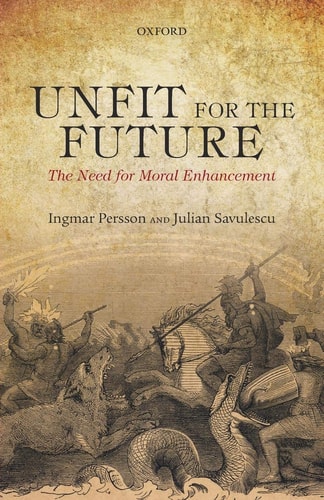
Unfit for the Future: The Need for Moral Enhancement
0
0
As an Amazon Associate and affiliate partner, Menrva Books earns from qualifying purchases. Learn more
Author Description
Unfit for the Future argues that the future of our species depends on our urgently finding ways to bring about radical enhancement of the moral aspects of our own human nature. We have rewritten our own moral agenda by the drastic changes we have made to the conditions of life on earth. Advances in technology enable us to exercise an influence that extends all over the world and far into the future. But our moral psychology lags behind and leaves us ill equipped to deal with the challenges we now face. We need to change human moral motivation so that we pay more heed not merely to the global community, but to the interests of future generations. It is unlikely that traditional methods such as moral education or social reform alone can bring this about swiftly enough to avert looming disaster, which would undermine the conditions for worthwhile life on earth forever. Persson and Savulescu maintain that it is likely that we need to explore the use of new technologies of biomedicine to change the bases of human moral motivation. They argue that there are in principle no philosophical or moral objections to such moral bioenhancement. Unfit for the Future challenges us to rethink our attitudes to our own human nature, before it is too late.
Menrva's Summary
THE THESIS
Can humanity survive the existential risks posed by its own technological power without undergoing a radical, biomedically-induced moral enhancement? Ingmar Persson and Julian Savulescu, both prominent scholars in practical ethics, argue that human moral psychology is evolutionarily ill-equipped to manage the global, long-term consequences of modern technological influence. They propose that traditional methods of moral improvement are insufficient to prevent impending catastrophe, necessitating an investigation into the ethical viability of biomedical interventions to alter human moral motivation.
THE SCOPE MAP
What You Will Find
- Analysis of the mismatch between Paleolithic moral psychology and modern technological capability.
- Philosophical arguments regarding the permissibility and necessity of moral bioenhancement.
- Examination of existential risks, including climate change and the potential for human-induced global destruction.
- Critique of traditional moral education and social reform as primary tools for rapid behavioral change.
THE AUTHORITY PERSPECTIVE
Experts in bioethics and philosophy frequently cite this work as a foundational text for the debate surrounding human enhancement and existential risk. Readers often note the rigorous, analytical density of the prose, which challenges conventional views on the limits of human nature and moral agency.
Page Count:
156
Publication Date:
2014-09-30
Publisher:
Oxford University Press
ISBN-10:
0198707924
ISBN-13:
9780198707929
Science
Philosophy
Sociology
Ethics
Bioethics
Technology
Community Tags
Similar Books