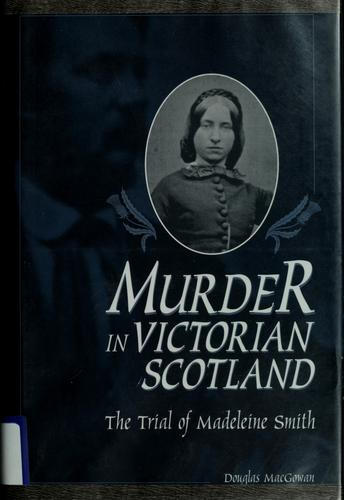
Murder in Victorian Scotland
0
0
As an Amazon Associate and affiliate partner, Menrva Books earns from qualifying purchases. Learn more
Author Description
Taking a new look at the life and 1857 trial of Madeleine Smith, the young Scottish woman accused of poisoning an undesired suitor, this book uses analyses of Smith's correspondence with the victim and her trial testimony to reveal much about Victorian society, Scottish law, the great divide between social classes, and the woman who received the nebulous verdict of "not proven." The verdict "not proven" is unique to Scotland: while allowing a defendant to go free, the verdict often carries a stigma. Emile L'Angelier, the son of a working-class family, and Madeleine Smith, the daughter of a wealthy Glasgow family were never properly introduced; however, they carried on an illicit affair that would end in tragedy. The absence of a clear verdict in this murder trial rocked Victorian Scotland and England. The story of the young girl who (presumably) poisoned her secret lover so that she could go forward with a family-arranged marriage would live on in print, on stage, and on the screen throughout the following century and a half. By analyzing the correspondence between Madeleine and Emile, the criminal trial testimony, and the pathology reports on Emile's body, Murder in Victorian Scotland gives the most complete picture to date of the events surrounding this infamous crime.
Menrva's Summary
THE THESIS
This book re-examines the 1857 trial of Madeleine Smith, a young Scottish woman accused of murdering her secret lover, Emile L'Angelier. The narrative delves into the illicit affair between Smith, from a wealthy Glasgow family, and L'Angelier, the son of a working-class family, which culminated in his death and her subsequent trial. The book analyzes Smith's correspondence, trial testimony, and pathology reports to illuminate Victorian society, the intricacies of Scottish law, the stark class divisions of the era, and the unique Scottish verdict of 'not proven'.
THE SCOPE MAP
- Detailed analysis of the correspondence between Madeleine Smith and Emile L'Angelier.
- Examination of Madeleine Smith's trial testimony.
- Review of pathology reports concerning Emile L'Angelier's death.
- Exploration of Victorian-era Scottish law and legal procedures.
- Discussion of the social stratification and class divides in 19th-century Scotland.
- In-depth look at the 'not proven' verdict and its implications.
- Contextualization of the Madeleine Smith case within the broader landscape of Victorian society and crime.
THE AUTHORITY PERSPECTIVE
This book offers a comprehensive examination of the Madeleine Smith trial, utilizing primary source analysis to shed light on a notorious Victorian crime. By dissecting the available evidence, the author aims to provide a more complete understanding of the events and the societal context in which they occurred. The work is positioned as a significant contribution to the study of Scottish legal history and Victorian social dynamics. The analysis of the unique 'not proven' verdict is a key element, offering insight into a distinct aspect of the Scottish legal system.
Page Count:
170
Publication Date:
1999-01-01
ISBN-10:
0275964310
True Crime
Non-Fiction
History
Scottish History
Legal History
Victorian Era
Community Tags
Similar Books