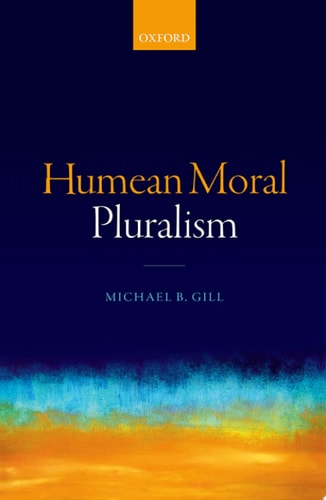
Humean Moral Pluralism
0
0
As an Amazon Associate and affiliate partner, Menrva Books earns from qualifying purchases. Learn more
Author Description
Michael B. Gill offers an original account of Humean moral pluralism. Moral pluralism is the view that there are different ultimate moral reasons for action, that those different reasons can sometimes come into conflict with each other, and that there exist no invariable ordering principles that tell us how to resolve such conflicts. If moral pluralism is true, we will at times have to act on moral decisions for which we can give no fully principled justification. Humeanism is the view that our moral judgments are based on our sentiments, that reason alone could not have given rise to our moral judgments, and that there are no mind-independent moral properties for our moral judgments to track. In this book, Gill shows that the combination of these two views produces a more accurate account of our moral experiences than the monistic, rationalist, and non-naturalist alternatives. He elucidates the historical origins of the Humean pluralist position in the works of David Hume, Adam Smith, and their eighteenth century contemporaries, and explains how recent work in moral psychology has advanced this position. And he argues for the position's superiority to the non-naturalist pluralism of W. D. Ross and the monism of Kantianism and consequentialism. The pluralist account of the content of morality has been traditionally perceived as belonging with non-naturalist intuitionism. The Humean sentimentalist account of morality has been traditionally perceived as not belonging with any view of morality's content at all. Humean Moral Pluralism explodes both those perceptions. It shows that pluralism and Humeanism belong together, and that they make a philosophically powerful couple.
Menrva's Summary
THE THESIS
Does the synthesis of Humean sentimentalism and moral pluralism provide a more accurate framework for understanding moral experience than traditional monistic or rationalist alternatives? Michael B. Gill, a scholar of moral philosophy, investigates the intersection of these two concepts by examining the historical foundations laid by David Hume and Adam Smith alongside contemporary findings in moral psychology. He argues that moral pluralism—the existence of conflicting ultimate moral reasons without a universal ordering principle—is best supported by the Humean view that moral judgments originate in human sentiment rather than mind-independent properties. By challenging the traditional association of pluralism with non-naturalist intuitionism, Gill constructs a robust defense of a sentimentalist pluralist model.
THE SCOPE MAP
What You Will Find
- Historical analysis of eighteenth-century moral philosophy including the works of David Hume and Adam Smith.
- Comparative critique of W. D. Ross’s non-naturalist intuitionism versus Kantian and consequentialist monism.
- Integration of modern moral psychology research to support the sentimentalist framework.
- A philosophical argument for the necessity of acting on moral decisions that lack fully principled justifications.
THE AUTHORITY PERSPECTIVE
Experts in the field recognize this work as a significant contribution to the ongoing debate between moral monism and pluralism. Readers frequently note the academic density of the prose, which is intended for scholars and advanced students of ethics.
Page Count:
288
Publication Date:
2014-08-12
Publisher:
Oxford University Press
ISBN-10:
0198714033
ISBN-13:
9780198714033
Philosophy
Pluralism
Conduct Of Life
Ethics
Community Tags
Other Editions(3)

Similar Books


Reader Comments
Share Your Thoughts
No comments yet. Be the first to share your thoughts!