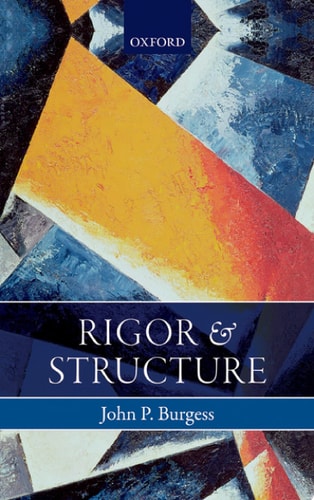
Rigor and Structure
0
0
As an Amazon Associate and affiliate partner, Menrva Books earns from qualifying purchases. Learn more
Author Description
While we are commonly told that the distinctive method of mathematics is rigorous proof, and that the special topic of mathematics is abstract structure, there has been no agreement among mathematicians, logicians, or philosophers as to just what either of these assertions means. John P. Burgess clarifies the nature of mathematical rigor and of mathematical structure, and above all of the relation between the two, taking into account some of the latest developments in mathematics, including the rise of experimental mathematics on the one hand and computerized formal proofs on the other hand. The main theses of Rigor and Structure are that the features of mathematical practice that a large group of philosophers of mathematics, the structuralists, have attributed to the peculiar nature of mathematical objects are better explained in a different way, as artefacts of the manner in which the ancient ideal of rigor is realized in modern mathematics. Notably, the mathematician must be very careful in deriving new results from the previous literature, but may remain largely indifferent to just how the results in the previous literature were obtained from first principles. Indeed, the working mathematician may remain largely indifferent to just what the first principles are supposed to be, and whether they are set-theoretic or category-theoretic or something else. Along the way to these conclusions, a great many historical developments in mathematics, philosophy, and logic are surveyed. Yet very little in the way of background knowledge on the part of the reader is presupposed.
Menrva's Summary
THE THESIS
This book investigates the fundamental tension between the mathematical ideals of rigorous proof and abstract structure, questioning how these concepts define modern mathematical practice. John P. Burgess, a prominent philosopher of logic and mathematics, examines the historical and contemporary evolution of these concepts. He argues that the structuralist view of mathematical objects is better understood as a byproduct of how rigor is implemented in modern research. By analyzing the shift from foundational first principles to the pragmatic indifference of the working mathematician, Burgess provides a new framework for understanding the discipline.
THE SCOPE MAP
What You Will Find
- Analysis of the historical development of mathematical rigor and structuralism.
- Examination of modern shifts including experimental mathematics and computerized formal proofs.
- Comparison of foundational frameworks such as set theory and category theory.
- Discussion on the practical methodology of mathematicians versus the theoretical concerns of philosophers.
THE AUTHORITY PERSPECTIVE
Experts recognize this work as a significant contribution to the philosophy of mathematics that bridges the gap between abstract theory and actual practice. Readers frequently note that the text remains accessible despite its complex subject matter, making it a valuable resource for both students and professionals in the field.
Page Count:
224
Publication Date:
2015-04-19
Publisher:
Oxford University Press
ISBN-10:
0198722222
ISBN-13:
9780198722229
Non-Fiction
Philosophy
Mathematics
Logic
Community Tags
Other Editions(4)


Similar Books



Reader Comments
Share Your Thoughts
No comments yet. Be the first to share your thoughts!