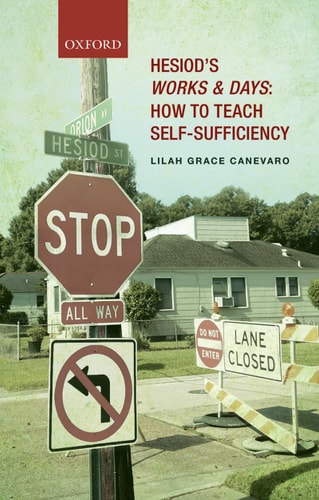
Hesiod's Works and Days: How to Teach Self-Sufficiency
0
0
As an Amazon Associate and affiliate partner, Menrva Books earns from qualifying purchases. Learn more
Author Description
Greek poet Hesiod's canonical archaic text, the Works and Days, was performed in its entirety, but was also relentlessly excerpted, quoted, and reapplied. In this volume, Lilah Grace Canevaro situates the poem within these two modes of reading and argues that the text itself, through Hesiod's complex mechanism of rendering elements detachable while tethering them to their context for the purposes of the poem, sustains both treatments. One of the poem's difficulties is that Hesiod gives remarkably little advice on how to negotiate these different modes of reading. Canevaro considers the didactic methods employed by Hesiod from two perspectives: in terms of the gaps he leaves, and of how he challenges his audience to fill them. She argues that Hesiod's reticence is linked to the high value he places on self-sufficiency, which creates a productive tension with the didactic thrust of the poem as teaching always involves a relationship of exchange and, at least up to a point, reliance and trust. Hesiod negotiates this potential contradiction by advocating not blind adherence to his teachings but thinking for oneself and working for one's lesson.Exploring key issues such as gender and genre, and persona and performance, this volume places this important poem within a wider context, revealing how it draws on and contributes to a tradition of usefulness.
Menrva's Summary
THE THESIS
This volume investigates how Hesiod’s archaic poem, Works and Days, balances the tension between its didactic nature and the author’s philosophical emphasis on individual self-sufficiency. Lilah Grace Canevaro, a scholar of classical literature, examines the poem’s dual existence as both a cohesive performance piece and a collection of detachable, quotable maxims. She argues that Hesiod intentionally employs a strategy of reticence, leaving gaps in his instruction that force the audience to engage in active, independent thought rather than passive reception. This methodology transforms the act of learning into a process of personal labor, aligning the reader’s experience with the poem’s core value of self-reliance.
THE SCOPE MAP
What You Will Find
- Analysis of the tension between didactic instruction and the necessity of independent critical thinking.
- Examination of the poem’s dual nature as both a unified performance and a source of modular, quotable wisdom.
- Exploration of thematic elements including gender, genre, persona, and the historical context of performance.
- Discussion of the pedagogical relationship between the teacher and the student in archaic Greek society.
THE AUTHORITY PERSPECTIVE
Scholars view this work as a significant contribution to the study of archaic Greek didactic poetry, particularly for its focus on the mechanics of Hesiod’s instructional style. Readers frequently note the academic density of the prose, which provides a rigorous framework for understanding how ancient texts were intended to be consumed and applied by their original audiences.
Page Count:
288
Publication Date:
2015-06-16
Publisher:
Oxford University Press
ISBN-10:
0198729545
ISBN-13:
9780198729549
Philosophy
Poetry
Literary Criticism
Hesiod
Ancient Greek
Criticism history
Didactic
Community Tags
Similar Books