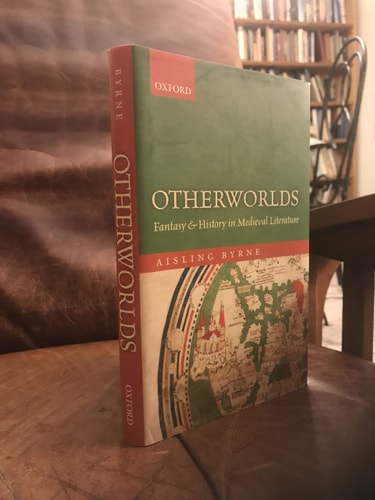
Otherworlds: Fantasy and History in Medieval Literature
0
0
As an Amazon Associate and affiliate partner, Menrva Books earns from qualifying purchases. Learn more
Author Description
This book offers a new perspective on the "otherworlds" of medieval literature. These fantastical realms are among the most memorable places in medieval writing, by turns beautiful and monstrous, alluring and terrifying. Passing over a river or sea, or entering into a hollow hill, heroes come upon strange and magical realms. These places are often very beautiful, filled with sweet music, and adorned with precious stones and rich materials. There is often no darkness, time may pass at a different pace, and the people who dwell there are usually supernatural. Sometimes such a place is exactly what it appears to be--the land of heart's desire--but, the otherworld can also have a sinister side, trapping humans and keeping them there against their will.Otherworlds: Fantasy and History in Medieval Literature takes a fresh look at how medieval writers understood these places and why they found them so compelling. It focuses on texts from England, but places this material in the broader context of literary production in medieval Britain and Ireland. The narratives examined in this book tell a rather surprising story about medieval notions of these fantastical places. Otherworlds are actually a lot less "other" than they might initially seem. Authors often use the idea of the otherworld to comment on very serious topics. It is not unusual for otherworld depictions to address political issues in the historical world. Most intriguing of all are those texts where locations in the real world are re-imagined as otherworlds. The regions on which this book focuses, Britain, Ireland, and the surrounding islands, prove particularly susceptible to this characterization.
Menrva's Summary
THE THESIS
This book investigates how medieval writers utilized the concept of the 'otherworld' not merely as a fantastical escape, but as a sophisticated literary device to engage with contemporary political and historical realities. Aisling Byrne, a scholar of medieval literature, examines a range of texts from England, Britain, and Ireland to challenge the assumption that these realms were purely escapist. By analyzing the intersection of geography and imagination, she argues that these supernatural spaces served as mirrors for the complex social and political landscapes of the medieval period.
THE SCOPE MAP
What You Will Find
- Analysis of medieval literary depictions of supernatural realms, including hollow hills and enchanted islands.
- Examination of the political and historical subtexts embedded within descriptions of fantastical geography.
- Comparative study of literary production across medieval Britain and Ireland.
- Investigation into the re-imagining of real-world locations as sites of the supernatural.
THE AUTHORITY PERSPECTIVE
Scholars and students of medieval literature frequently cite this work for its nuanced approach to the relationship between fantasy and historical context. Experts highlight the text as a valuable contribution to the study of how medieval authors utilized myth to navigate the complexities of their own political environments.
Page Count:
240
Publication Date:
2016-02-17
Publisher:
Oxford University Press
ISBN-10:
0198746008
ISBN-13:
9780198746003
History
Fantasy
English
English & College Success
Criticism history
Folklore
In literature
Literary Criticism
Community Tags
Similar Books