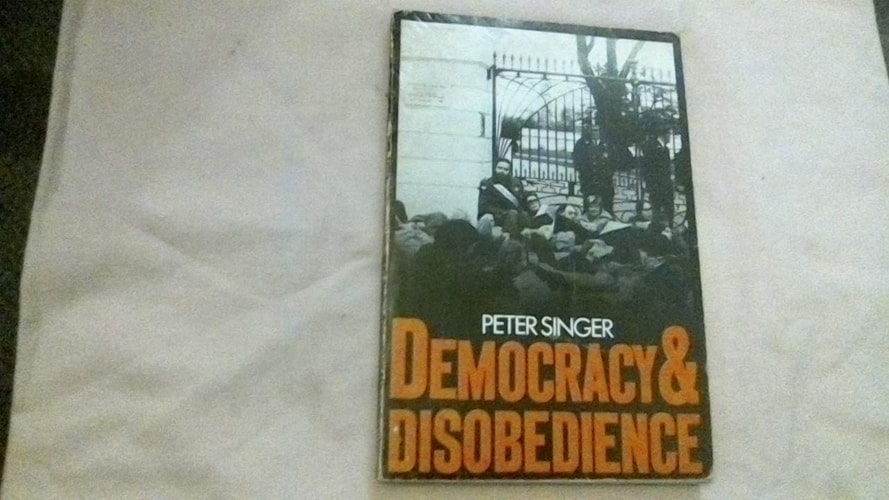
Democracy and Disobedience
0
0
As an Amazon Associate and affiliate partner, Menrva Books earns from qualifying purchases. Learn more
Author Description
Asking, "Why, or in what circumstances, ought we to obey the law?", this work focuses on the common view that disobedience to the law, while justifiable in a dictatorship, is much more difficult to justify in a democracy. It then develops a theory of political obligation in an ideal democracy. After discussing various forms of disobedience, the author wonders to what extent systems of government approximate to this ideal and why Western democracies fall short of it. The book concludes with a brief case the development of disobedience in Northern Ireland.
Menrva's Summary
THE THESIS
This work investigates the moral justification for civil disobedience within the framework of a democratic state. Peter Singer, a prominent moral philosopher, examines the tension between the duty to obey the law and the individual's conscience. He constructs a theoretical model of an ideal democracy to determine whether political obligation remains absolute when a government fails to meet its democratic standards.
THE SCOPE MAP
What You Will Find
- A theoretical framework for political obligation in ideal democratic systems
- An analysis of various forms of civil disobedience and their moral implications
- A critical evaluation of how contemporary Western democracies deviate from democratic ideals
- A case study examining the development of disobedience in Northern Ireland
THE AUTHORITY PERSPECTIVE
Scholars frequently cite this text as a foundational contribution to the ethics of political protest and the limits of state authority. Readers often note the clarity of the prose, which makes complex philosophical arguments accessible to those outside of academic circles.
Page Count:
158
Publication Date:
1973-01-01
Publisher:
Oxford University Press/Clarendon Press
ISBN-10:
0198750277
ISBN-13:
9780198750277
Politics
Philosophy
Ethics
Political Theory
Democracy
Government Resistance To
Community Tags
Other Editions(2)
Similar Books