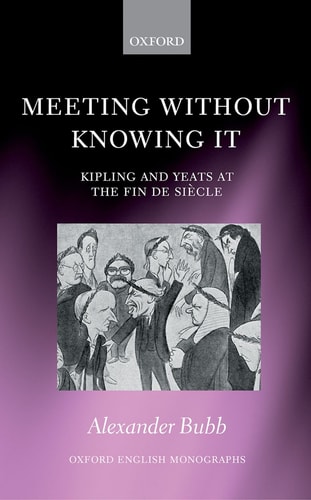
Meeting Without Knowing It: Kipling and Yeats at the Fin de Siecle
0
0
As an Amazon Associate and affiliate partner, Menrva Books earns from qualifying purchases. Learn more
Author Description
Meeting Without Knowing It compares Rudyard Kipling and W.B. Yeats in the formative phase of their careers, from their births in 1865 up to 1903. The argument consists of parallel readings wed to a biographic structure. Reading the two poets in parallel often yields remarkable discursive echoes. For example, both men were similarly preoccupied with the visual arts, with heroism, with folklore, balladry and the demotic voice. Both struck vatic postures, and made bids for public authority premised on an appeal to what they considered the "mythopoeic" impulse in fin de siecle culture. Meeting Without Knowing It dentifies these mutual echoes in their poetry and political rhetoric, before charting them against intersections in their lives.Kipling and Yeats were, for much of their careers, irreconcilable political enemies. However, a cross-reading of the two poets' bardic ambitions, heroic tropes, and interpretations of history reveals that, to achieve their opposed political ends, they frequently partook of a common discourse. Supplementing this analysis with biographical context, we can trace these shared concerns to their late nineteenth century artistic upbringing, and to the closely linked social circles that they inhabited in fin de siecle London. It is, in fact, their very mutuality during the 1890s which lent rancor to their ideological division after the Boer War. In turn, acrimony and denunciation only served to bind together all the more intimately, in an argumentative spiral of revolving discourses, two men who were often proximate but who actually met only in cartoons and satirical gossip.
Menrva's Summary
THE THESIS
This work investigates the shared discursive landscape and parallel artistic development of Rudyard Kipling and W.B. Yeats during the fin de siecle period. Alexander Bubb utilizes a biographical framework to examine how these two figures, despite their eventual status as political adversaries, drew upon identical cultural impulses and social circles in late nineteenth-century London. By analyzing their poetry and political rhetoric, Bubb argues that their later ideological conflict was rooted in a profound, underlying mutuality of bardic ambition and mythopoeic interest.
THE SCOPE MAP
What You Will Find
- Comparative analysis of Kipling and Yeats from 1865 to 1903.
- Examination of shared preoccupations with folklore, balladry, and the demotic voice.
- Biographical context regarding the social circles of fin de siecle London.
- Analysis of the intersection between artistic upbringing and political rhetoric.
THE AUTHORITY PERSPECTIVE
Scholars recognize this text as a rigorous contribution to the study of late-Victorian and Edwardian literary history. Readers frequently note the academic density of the prose and the precision with which Bubb maps the intellectual connections between these two disparate figures.
Page Count:
304
Publication Date:
2016-04-11
Publisher:
Oxford University Press
ISBN-10:
019875387X
ISBN-13:
9780198753872
Biography
History
Poetry
Literary Criticism
19th Century
Community Tags
Similar Books