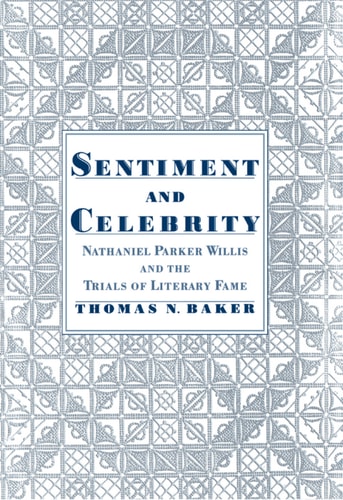
Sentiment and Celebrity: Nathaniel Parker Willis and the Trials of Literary Fame
0
0
As an Amazon Associate and affiliate partner, Menrva Books earns from qualifying purchases. Learn more
Author Description
How did the stately, republican literary world of Washington Irving and James Fenimore Cooper give way to the sensationalist, personality-saturated mass market society of the late nineteenth century? In answering this question, Sentiment and Celebrity tells the story of a man the New York Times once called "the most talked-about author in America." A widely admired, if controversial, master of the sentimental appeal, poet and "magazinist" Nathaniel Parker Willis (1806-1867) was a pioneer in the modern business of celebrity. In his heyday, he knew both popularity and success as few other American writers had. Willis, who became the gossip-dishing darling of the middle class and whose sister was the popular writer Fanny Fern (of Ruth Hall fame), was a shrewdly self-styled man of letters who attained international fame by publicizing the renowned figures of the day, including himself, and by playing to, or playing upon, the sentimental desires of his readers. By the 1840s, he could count himself among the nation's highest paid writers and most influential arbiters of fashion and feeling (especially with genteel women), though he could also describe himself, accurately enough, as one of the "best abused" literary men of his generation. With fame and self-promotion came unexpected, perhaps unforeseeable, burdens, and scandal followed eventually.By charting the various controversies that surrounded Willis, this book shows how the cultural and commercial impulses that fostered antebellum America's new love of fame and fashion drew sustenance from the concurrent allure of genteel cultivation and sentiment. Still, perennial tensions between desires for privacy and the invasive impulses of publicity, and between desires for sincerity and the appeal of social and commercial artifice, rendered this cultural conjunction highly unstable. Readers of Willis were both attracted to and disturbed by his written work and his very person; he introduced new possibilities for fashion, tas
Menrva's Summary
THE THESIS
How did the transition from a stately, republican literary culture to a sensationalist, celebrity-driven mass market occur in nineteenth-century America? Thomas N. Baker investigates this shift through the career of Nathaniel Parker Willis, a writer who pioneered the modern business of celebrity. By analyzing Willis's strategic use of sentiment and self-promotion, Baker argues that the rise of mass media and the commodification of personality fundamentally altered the relationship between authors and the public.
THE SCOPE MAP
What You Will Find
- An examination of the antebellum American literary marketplace and the rise of the magazine industry.
- Analysis of the tension between private identity and public persona in the nineteenth century.
- Case studies of Willis's interactions with contemporary figures and his influence on middle-class fashion and social norms.
Scope Limits
- The book focuses primarily on the life and career of Nathaniel Parker Willis rather than providing a comprehensive history of all nineteenth-century American authors.
- It does not provide an exhaustive bibliography of Willis's entire body of work, focusing instead on his role as a cultural figure.
THE AUTHORITY PERSPECTIVE
Scholars and historians recognize this work as a significant contribution to the study of American literary celebrity and the evolution of media culture. Readers frequently note the academic rigor of the prose and the depth of the historical research presented by the author.
Page Count:
264
Publication Date:
1998-01-01
Publisher:
Oxford University Press
ISBN-10:
0190283823
ISBN-13:
9780190283827
Biography
History
Literary Criticism
American History
English
English & College Success
19th Century
Authorship
Community Tags
Similar Books