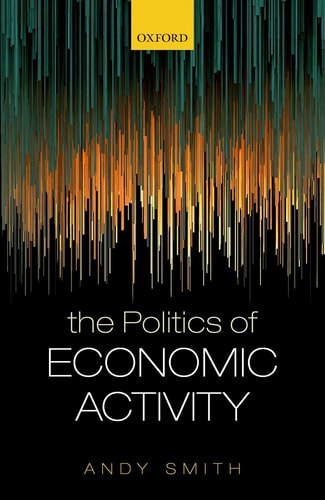
The Politics of Economic Activity
0
0
As an Amazon Associate and affiliate partner, Menrva Books earns from qualifying purchases. Learn more
Author Description
The Politics of Economic Activity confronts head-on deeply rooted understandings of how politics affects economics. The book proposes a robust, incisive alternative definition of politics: the mobilization of values to change or reproduce the institutions that orientate, and indeed make possible, economic activity.Drawing upon constructivist strands of institutionalism, political sociology, and industrial economics, this definition generates an analytical framework for understanding the 'political work' that constantly orientates the behaviour of both firms and public authorities. Specifically, a fundamental tension between the values of freedom and security is consistently examined. This is analysed by looking at conflicts within the definition of these two values, but also by examination of mobilizations of two subordinate values: equality and tradition. A hypothesis examined throughout the book's empirical chapters is that equality and tradition play either supporting, intervening, or silent roles within the freedom-security relationship that structures contemporary capitalism.Structured around controversies concerning the politics of economic activity at the global, European, national and local scales, the book examines the pharmaceutical, wine, local food, and car industries, as well as cross-cutting policies concerning issues such as regulating labour markets and inter-firm competition, geographical indications, and local economic development. Overall, the book's aim is to advocate a mode of thinking and research which challenges orthodox and dominant approaches to economics and its politics. It does so by placing a politics that is comprehensible, and therefore both 'studyable' and 'actionable', back at the centre of reflection about the economic and the political.
Menrva's Summary
THE THESIS
This book investigates how the mobilization of values shapes the institutions that define and orient economic activity. Author Andy Smith, drawing on constructivist institutionalism and political sociology, argues that politics is not merely an external force acting upon economics but an internal mechanism that constantly structures the behavior of firms and public authorities. By examining the tension between the values of freedom and security, the text provides a framework for analyzing how equality and tradition influence the trajectory of contemporary capitalism.
THE SCOPE MAP
What You Will Find
- An analytical framework for identifying the 'political work' within economic institutions.
- A comparative study of the pharmaceutical, wine, local food, and car industries.
- An examination of the interplay between the values of freedom, security, equality, and tradition.
- A multi-scalar analysis covering global, European, national, and local economic policies.
THE AUTHORITY PERSPECTIVE
Experts identify this work as a significant contribution to political economy that challenges orthodox economic models by re-centering political agency. Readers frequently note the academic density of the prose, which is intended for scholars and students of institutional sociology and political science.
Page Count:
208
Publication Date:
2016-11-08
Publisher:
Oxford University Press
ISBN-10:
0198788150
ISBN-13:
9780198788157
Economics
Economics
Capitalism
Sociology
Community Tags
Other Editions(3)
Similar Books



Reader Comments
Share Your Thoughts
No comments yet. Be the first to share your thoughts!