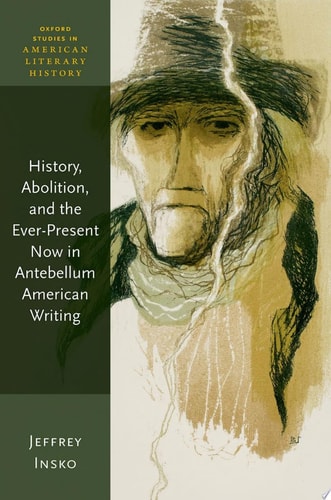
History, Abolition, and the Ever-Present Now in Antebellum American Writing
0
0
As an Amazon Associate and affiliate partner, Menrva Books earns from qualifying purchases. Learn more
Author Description
History, Abolition, and the Ever-Present Now in Antebellum American Writing examines the meaning and possibilities of the present and its relationship to history and historicity in a number of literary texts; specifically, the writings of several figures in antebellum US literary history―some, but not all of whom, associated with the period's romantic movement. Focusing on nineteenth-century writers who were impatient for social change, like those advocating for the immediate emancipation of slaves, as opposed to those planning for a gradual end to slavery, the book recovers some of the political force of romanticism.Through close readings of texts by Washington Irving, John Neal, Catharine Sedgwick, Frederick Douglass, Ralph Waldo Emerson, and Herman Melville, the book argues that these writers practiced forms of literary historiography that treat the past as neither a reflection of present interests nor as an irretrievably distant 'other', but as a complex and open-ended interaction between the two. In place of a fixed and linear past, these writers imagine history as an experience rooted in a fluid, dynamic, and ever-changing present. The political, philosophical, and aesthetic disposition Insko calls 'romantic presentism' insists upon the present as the fundamental sphere of human action and experience-and hence of ethics and democratic possibility.
Menrva's Summary
THE THESIS
This book investigates how antebellum American writers conceptualized the relationship between the present moment and historical time to advance political and social change. Jeffrey Insko, an associate professor of English, utilizes a framework of 'romantic presentism' to analyze how nineteenth-century authors moved away from linear historical models. By examining the works of figures such as Frederick Douglass and Ralph Waldo Emerson, the author argues that these writers viewed the present as the primary site for ethical action and democratic reform, rather than treating the past as a static or distant entity.
THE SCOPE MAP
What You Will Find
- Analysis of nineteenth-century literary historiography and the romantic movement.
- Close readings of primary texts by Washington Irving, John Neal, Catharine Sedgwick, Frederick Douglass, Ralph Waldo Emerson, and Herman Melville.
- Exploration of the political tension between immediate abolitionism and gradualist approaches to slavery.
- A theoretical framework defining 'romantic presentism' as a mode of historical engagement.
THE AUTHORITY PERSPECTIVE
Scholars in the field of American literary history identify this work as a significant contribution to the study of nineteenth-century temporalities and political aesthetics. Readers frequently note the academic density of the prose, which is intended for advanced students and researchers of antebellum literature.
Page Count:
272
Publication Date:
2019-02-13
Publisher:
Oxford University Press
ISBN-10:
0198825641
ISBN-13:
9780198825647
History
In literature
English
Romanticism
American
English & College Success
Literary Criticism
Abolitionism
Political Philosophy
Community Tags
Other Editions(2)
Similar Books