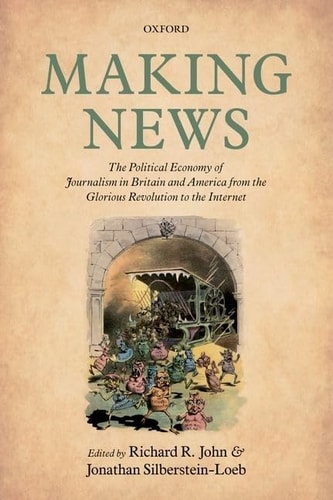
Making News: The Political Economy of Journalism in Britain and America from the Glorious Revolution to the Internet
0
0
As an Amazon Associate and affiliate partner, Menrva Books earns from qualifying purchases. Learn more
Author Description
This book charts the rise and fall of the newspaper as the primary medium for the conveyance of news. The book focuses on two of the most influential media markets in the modern world-Great Britain and the United States between 1688 and 1995.In 1688, Parliament created institutional arrangements that would hasten the rise of the newspaper as the dominant medium for the circulation of news. In 1995, the National Science Foundation commercialized the Internet, encouraging an astonishing proliferation of information on all manner of topics, including the news. Per capita newspaper circulation had been declining for decades, partly due to shifting social norms, and partly due to the rise of broadcast news. The Internet exacerbated this trend, partly because it provided a cheaper news source, and partly because it quickly became a superior vehicle for advertising, a major source of revenue for newspaper publishers for over two-hundred-years.However, only rarely has advertising revenue and direct sales covered costs. Almost never has the demand for news generated the revenue necessary for its supply. Non-market institutional arrangements have ranged from direct government subsidies to organizational forms that enabled news organizations to cooperate. From a historical perspective, the large profits reaped by a handful of newspaper publishers in the post-Second World War era were anomalous, and in no sense a baseline for public policy. Never again will the newspaper be the dominant news medium. To guarantee an informed citizenry in the future, it is necessary to understand how the news business worked in the past.This book is organized around eight essays-each written by a distinguished specialist, and each explicitly comparative. Its theme is the indispensability in both Great Britain and the United States of non-market institutional arrangements in the provisioning of news.
Menrva's Summary
THE THESIS
This book investigates the historical reliance of the newspaper industry on non-market institutional arrangements to sustain the supply of news in Great Britain and the United States. Jonathan Silberstein-Loeb and Richard R. John curate a collection of essays from distinguished specialists to analyze the economic structures that supported journalism from the Glorious Revolution of 1688 through the commercialization of the Internet in 1995. The authors argue that the high profitability of newspapers in the post-World War II era was a historical anomaly rather than a sustainable business model, emphasizing that direct sales and advertising have rarely covered the costs of news production.
THE SCOPE MAP
What You Will Find
- A comparative analysis of media markets in Great Britain and the United States spanning over three centuries.
- Examination of institutional frameworks, including government subsidies and cooperative organizational models, that enabled news production.
- Historical data regarding the decline of newspaper circulation and the impact of broadcast media and the Internet on advertising revenue.
- Eight specialized essays detailing the political economy of news provisioning across distinct historical eras.
THE AUTHORITY PERSPECTIVE
Experts recognize this collection as a rigorous contribution to media history and political economy, providing a necessary corrective to the assumption that news markets are self-sustaining. Readers frequently note the academic density of the prose and the depth of the comparative historical research presented by the contributors.
Page Count:
288
Publication Date:
2018-07-24
Publisher:
Oxford University Press
ISBN-10:
0198820658
ISBN-13:
9780198820659
History
Non-Fiction
Mass media
Great Britain
Political Aspects
Communication
Mass Communication
Media Studies
Journalism
Community Tags
Similar Books










Reader Comments
Share Your Thoughts
No comments yet. Be the first to share your thoughts!