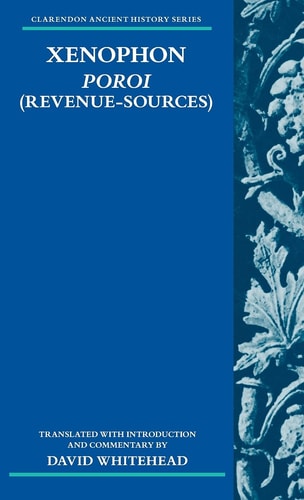
Xenophon: Poroi (Revenue-Sources)
0
0
As an Amazon Associate and affiliate partner, Menrva Books earns from qualifying purchases. Learn more
Author Description
This volume showcases for the first time in the Clarendon Ancient History Series one of the best-known prose authors of classical Athens: Xenophon.Poroi (or, Revenue-Sources) was the final work of his large and varied output, written in the mid-350s BCE at a time when Athens had failed to prevent the collapse of her second Aegean 'empire', and was impoverished and demoralized in consequence. Back in Athens after a lifetime abroad, the elderly Xenophon took an optimistic view of the plight of his fellow-citizens: though their days as a free-spending imperial power may have been over, they could fall back on the city's own, unique assets - both human (the large community of resident and visiting foreigners) and material (the natural resources of Attica itself, notably the silver-mines) - strategically exploiting them in order to set the city on the road to peace and prosperity. Xenophon fleshed out this general position with many specific proposals, in doing so situating Poroi not only in a tradition of early economic thought, but also in the realm of practical politics.Framed by a General Introduction and the first-ever full Commentary on the work in English, this new and unprecedentedly accurate translation offers an authoritative yet accessible overview of the text, its context, and its historical, socio-political, and economic implications that will be invaluable to both students new to the work and to more experienced scholars. Challenging the view that there is a significant overlap between Xenophon's ideas and the policies associated (in the 350s and 340s) with Euboulos, it argues, rather, that Poroi was ahead of its time and in fact anticipated the programme of Athens' leading statesman of the 330s and 320s: Lykourgos.
Menrva's Summary
THE THESIS
*This volume investigates the economic and political strategies proposed by Xenophon in his final work, Poroi, to restore Athenian prosperity following the collapse of the second Aegean empire.* David Whitehead, a scholar of classical history, provides a rigorous analysis of the text by situating it within the mid-350s BCE socio-political landscape. The book argues that Xenophon’s proposals were not merely reactive but forward-thinking, anticipating the later administrative reforms of Lykourgos rather than aligning with the contemporary policies of Euboulos.
THE SCOPE MAP
What You Will Find
- A detailed examination of the mid-4th century BCE Athenian economic crisis and the loss of imperial revenue.
- An analysis of Xenophon’s specific proposals regarding the exploitation of Attica’s silver mines and the integration of resident foreigners.
- A comprehensive English translation paired with the first full-scale academic commentary on the Poroi.
- A critical reassessment of Xenophon’s position within the history of early economic thought and practical Athenian politics.
THE AUTHORITY PERSPECTIVE
Experts recognize this volume as a foundational resource for students and scholars of classical Athenian history due to its unprecedentedly accurate translation and detailed commentary. Readers frequently note the academic density of the prose, which provides a thorough contextualization of Xenophon’s final work within the broader framework of ancient political economy.
Page Count:
368
Publication Date:
2019-06-04
Publisher:
Oxford University Press
ISBN-10:
019883442X
ISBN-13:
9780198834427
Economics
History
Ancient History
Community Tags
Similar Books