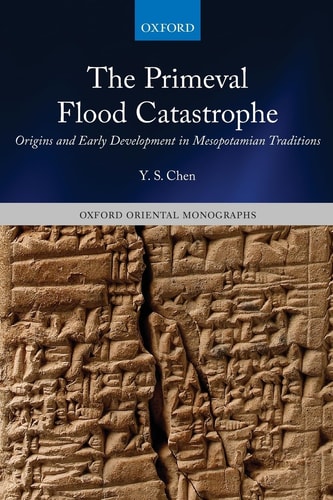
Primeval Flood Catastrophe: Origins and Development in Mesopotamian Literature
0
0
As an Amazon Associate and affiliate partner, Menrva Books earns from qualifying purchases. Learn more
Author Description
Previous research on Mesopotamian Flood traditions tended to focus on a few textual sources. How the traditions originated and developed as a whole has not been seriously investigated. By systematically examining a large body of relevant cuneiform sources of diverse genres from the Early Dynastic III period (ca. 2600-2350 B.C.) to the end of the first millennium B.C., this book observes that it is during the Old Babylonian period (ca. 2000-1600) and classical attestations of the Flood traditions are found. On linguistic, conceptual and literary-historical grounds, the book argues that the Flood traditions emerged relatively late in Sumerian traditions. It traces different evolutionary stages of the Flood traditions, from the emergence of the Flood motif within the socio-political and cultural contexts of the early Isin dynasty (ca. 2017-1896 B.C.), to the diverse mythological representations of the motif in literary traditions, to the historicisation of the motif in chronography, and finally to the interactions between various strands of the Flood traditions and other Mesopotamian literary traditions, such as Sumerian and Babylonian compositions about Gilgames.By uncovering the processes through which the Flood traditions were constructed, the book offers a valuable case study on the complex and dynamic relationship between myth-making, the development of literature, the rise of historical consciousness and historiography, and socio-political circumstances in the ancient world. The origins and development of the Flood traditions examined in the book, furthermore, represent one of the best documented examples illustrating the continuities and changes in Mesopotamian intellectual, linguistic, literary, socio-political and religious history over the course of two and a half millennia.
Menrva's Summary
THE THESIS
This book investigates the origins and evolutionary development of Mesopotamian Flood traditions by analyzing a comprehensive corpus of cuneiform sources spanning from the Early Dynastic III period to the end of the first millennium B.C. Chen, a scholar of ancient Near Eastern studies, utilizes a systematic examination of diverse literary and historical texts to challenge previous narrow interpretations of these traditions. The author argues that the Flood motif emerged relatively late in Sumerian history, specifically during the Old Babylonian period, and evolved through complex interactions between socio-political contexts and literary myth-making. By tracing these developments, the work provides a framework for understanding how historical consciousness and historiography were constructed in the ancient world.
THE SCOPE MAP
What You Will Find
- A comprehensive analysis of cuneiform sources from the Early Dynastic III period through the first millennium B.C.
- A chronological tracing of the Flood motif from the early Isin dynasty to later historical and mythological representations.
- Comparative studies between Flood traditions and other Mesopotamian compositions, including the Gilgamesh epics.
- An examination of the intersection between myth-making, linguistic evolution, and socio-political shifts in ancient Mesopotamia.
THE AUTHORITY PERSPECTIVE
Experts recognize this work as a rigorous contribution to the study of ancient Near Eastern literature and historiography. Readers frequently note the academic density of the prose, which serves as a foundational text for scholars interested in the development of Mesopotamian intellectual history.
Page Count:
358
Publication Date:
2019-06-27
Publisher:
Oxford University Press
ISBN-10:
0198843410
ISBN-13:
9780198843412
Religion
History
Cuneiform inscriptions
Archaeology
Mythology
Mesopotamia
Ancient History
Literary Criticism
Community Tags
Similar Books