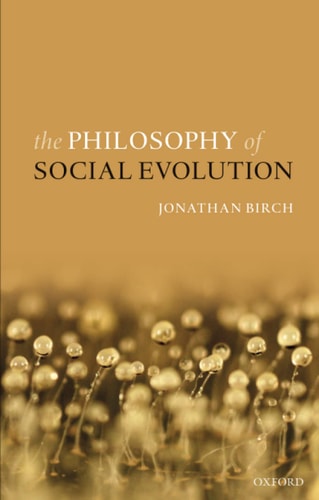
The Philosophy of Social Evolution
0
0
As an Amazon Associate and affiliate partner, Menrva Books earns from qualifying purchases. Learn more
Author Description
From mitochondria to meerkats, the natural world is full of spectacular examples of social behaviour. In the early 1960s Bill Hamilton changed the way we think about how such behaviour evolves. He introduced three key innovations - now known as Hamilton's rule, kin selection, and inclusive fitness - which have been enormously influential, but which remain the subject of fierce controversy.Hamilton's pioneering work kick-started a research program now known as social evolution theory. This is a book about the philosophical foundations and future prospects of that program. Part I, "Foundations", is a careful exposition and defence of Hamilton's ideas, with a few modifications along the way. In Part II, "Extensions", Jonathan Birch shows how these ideas can be applied to phenomena including cooperation in micro-organisms, cooperation among the cells of a multicellular organism, and culturally evolved cooperation in the earliest human societies. Birch argues that real progress can be made in understanding microbial evolution, evolutionary transitions, and human evolution by viewing them through the lens of social evolution theory, provided the theory is interpreted with care and adapted where necessary.The Philosophy of Social Evolution places social evolution theory on a firm philosophical footing and sets out exciting new directions for further work.
Menrva's Summary
THE THESIS
This book investigates the philosophical foundations and future applications of social evolution theory, specifically addressing the controversies surrounding kin selection and inclusive fitness. Jonathan Birch, a philosopher of science, provides a rigorous defense of W.D. Hamilton's core innovations while proposing necessary adaptations to the theory. By analyzing the logical structure of Hamilton's rule, the author establishes a framework for applying these concepts to diverse biological and cultural phenomena, ranging from microbial cooperation to the development of early human societies.
THE SCOPE MAP
What You Will Find
- A detailed exposition of Hamilton's rule, kin selection, and inclusive fitness.
- Philosophical analysis of evolutionary transitions and the nature of cooperation.
- Case studies applying social evolution theory to micro-organisms and multicellular organisms.
- Theoretical frameworks for understanding culturally evolved cooperation in human evolution.
THE AUTHORITY PERSPECTIVE
Experts recognize this work as a significant contribution to the philosophy of biology, providing a necessary bridge between theoretical evolutionary biology and conceptual analysis. Readers frequently note the academic density of the prose, which is intended for those with a background in evolutionary theory or philosophy of science.
Page Count:
280
Publication Date:
2019-10-17
Publisher:
Oxford University Press
ISBN-10:
0198851685
ISBN-13:
9780198851684
Science
Philosophy
Social Science
Biology
Evolutionary Biology