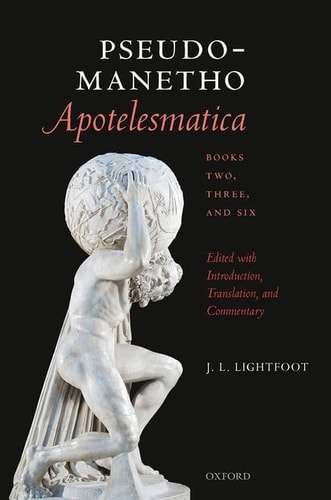
Pseudo-Manetho, Apotelesmatica, Books Two, Three, and Six: Edited with Introduction, Translation, and Commentary
0
0
As an Amazon Associate and affiliate partner, Menrva Books earns from qualifying purchases. Learn more
Author Description
This is the first commentary in any language on three of the books of ancient Greek astrological poetry ascribed to the Egyptian priest Manetho. Manetho, who became a figure for recondite wisdom, came to be credited with a series of didactic poems which list outcomes for planetary set-ups in a horoscope or birth chart. This book contends that we can learn a great deal from this material about the intellectual, cultural, social, and literary history of the world in which it was written--Hadrianic Egypt, and the second-century Roman Empire at large. Its descriptions of the kinds of person who are born under happy and unhappy configurations of stars speak to the lived realities, aspirations, and fears of the astrologer's clientele. Given astrology's enormous contemporary prestige, this means we are offered insights into the mental universe and values of the common man, l'homme moyen sensuel, that élite literature largely bypasses.The volume addresses current work on the emotions and popular ethics. It also brings to the fore a neglected witness to a type of imperial didactic poetry--functional, technical in content, and yet sharing a degree of artistrywith better-known poets such as Dionysius the Periegete. The Manethonian poems are placed in the context of other ancient astrological literature--much of it very different in idiom, complexity, and method--but also in the wider one of other divinatory texts, philosophical writing, and the novel. There is a Greek text with English translation and an apparatus with parallel material to enable comparison with related works.
Menrva's Summary
THE THESIS
This volume investigates the intellectual and cultural significance of the Apotelesmatica, a collection of ancient Greek astrological poems attributed to the Egyptian priest Manetho. J. L. Lightfoot provides a comprehensive scholarly framework, utilizing the Greek text, a new English translation, and extensive commentary to analyze these didactic works. The author argues that these poems serve as a vital window into the social values, fears, and aspirations of the common populace in Hadrianic Egypt and the broader second-century Roman Empire, offering insights often absent from elite literature.
THE SCOPE MAP
What You Will Find
- A critical edition and translation of books two, three, and six of the Apotelesmatica.
- Analysis of the poems as functional, technical, and artistic imperial didactic literature.
- Comparative study of Manethonian texts against other ancient divinatory, philosophical, and narrative works.
- Examination of the lived realities and popular ethics of the Roman Empire's common citizens through the lens of astrological belief.
THE AUTHORITY PERSPECTIVE
Experts recognize this work as the first comprehensive commentary on these specific astrological poems, filling a significant gap in classical scholarship. Scholars frequently highlight the text's utility for understanding the intersection of technical literature and social history in the Roman world.
Page Count:
995
Publication Date:
2021-01-10
Publisher:
Oxford University Press
ISBN-10:
0198858787
ISBN-13:
9780198858782
Poetry
History
Astrology
Literary Criticism
Ancient History
Community Tags
Similar Books