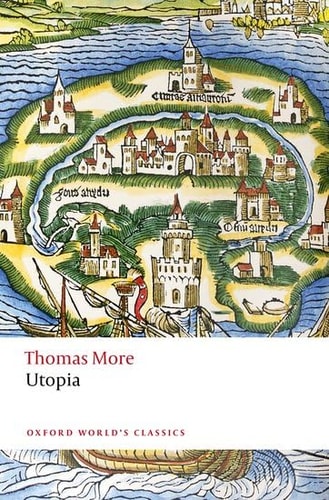
Utopia
0
0
As an Amazon Associate and affiliate partner, Menrva Books earns from qualifying purchases. Learn more
Author Description
Utopia One Of These Topics, Germane To More's Time, Is That Of Enclosure: The Practice Of Fencing In ('enclosing') Common Land For Private Use, Frequently The Profitable Practice Of Sheep-rearing For Wool Production. The Discussion Of Enclosure Results In Perhaps The Most Famous Passage From Utopia, In Which Hythloday Suggests That The Sheep Of England Are 'devourers Of Men', Because Their (enclosed) Grazing Land Causes The Deaths Of Those Who Might Have Otherwise Taken Their Livelihood From It. The Critique Of Enclosure Connects More's Mission To The Low Countries (his Negotiations Primarily Concerned The Cloth Trade) With The Theme Of Private Versus Common Property, Which Runs Through The Text. At Last, Hythloday Brings The Conversation To A Discussion Of An Island He Had Visited In The New World, Called Utopia, In Which There Is No Private Property. With Private Property Abolished, Hythloday Posits That So Too Is Eliminated Pride, Which He Holds To Be The Greatest Of All Sins And The Source Of All Ills In Contemporary European Society. In Book Ii, Hythloday Is The Narrator, And Focus Shifts To His Lengthy Description Of The Island Of Utopia. This Longer Book Covers Utopia's Geography, Customs, Laws, Culture, Military Exploits, History And Religion, Among Other Things. The Island Of Utopia Stands In Stark Contrast To Its Parallel: England. Whereas In England Social Fictions Such As Property And Rank Divide The People, In Utopia Equality Keeps All Its Citizenry United And, As A Result, Happy. There Is No Private Property In Utopia; Homes Are Assigned By Lottery And Periodically Exchanged. Though There Are Roles-such As Priest Or Statesman-which Are Accorded Respect, They Bring Them No Sense Of Elevation In Anything Like A Social Hierarchy. Utopia Is Largely Tolerant Of Religious Pluralism (with A Few Notable Exceptions) And Has Not Previously Been Made Aware Of Christianity. Its Religion Is Based On Reason, An Experiment In Imagining A Pre-christian 'natural Religi
Menrva's Summary
THE PULSE
The central conflict arises from the fundamental tension between the corrupt, property-driven structures of 16th-century Europe and the idealized, communal existence of the island of Utopia. Raphael Hythloday, a traveler and philosopher, presents his observations of the island to Thomas More, contrasting the social inequalities of England with the egalitarian, property-free society of the Utopians. The narrative framework utilizes a dialogue-based structure in Book I, transitioning into a descriptive, travelogue-style account in Book II. Hythloday acts as the primary voice, challenging the reader to consider the logical consequences of abolishing private ownership and social hierarchy.
INSIDE THE PAGES
- Use of the dialogue format to establish philosophical debate
- Detailed descriptions of the island's geography and urban planning
- Exploration of the abolition of private property as a social cure
- Critique of contemporary European political and economic systems
- Examination of religious pluralism and natural religion
- Analysis of social hierarchy versus communal equality
- Inclusion of satirical commentary on human pride and greed
- Systematic breakdown of Utopian laws, customs, and military practices
THE COLLECTIVE ECHO
Readers and critics frequently highlight the text as a foundational work of political philosophy that continues to provoke debate regarding the viability of communal living. Discussion often centers on whether More intended the island as a genuine blueprint for society or as a satirical critique of the limitations of his own era. The pacing is deliberate, shifting from the argumentative intensity of the first book to the descriptive, almost clinical, observations of the second. Scholars often emphasize the contrast between the rigid social structures of the Renaissance and the fluid, lottery-based housing and governance of the Utopians. The work remains a central point of reference for those examining the evolution of utopian literature and the history of political thought.
Page Count:
192
Publication Date:
2025-08-07
Publisher:
Oxford University Press
ISBN-10:
019886020X
ISBN-13:
9780198860204
Philosophy
Satire
classic
British & Irish
Social Science
Community Tags
Similar Books