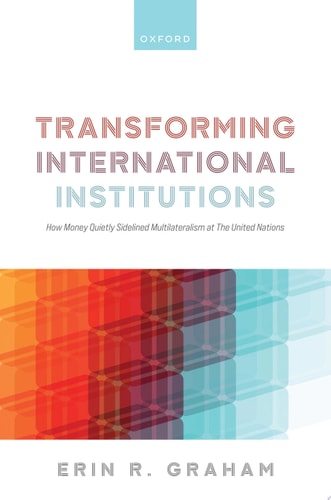
Transforming International Institutions: How Money Quietly Sidelined Multilateralism at The United Nations
0
0
As an Amazon Associate and affiliate partner, Menrva Books earns from qualifying purchases. Learn more
Author Description
Transforming International Institutions illuminates how a slow, quiet, subterranean process can produce big, radical change in international institutions and organizations. Drawing on historical institutionalism and interpretive tools of international law, Graham provides a novel theory of uncoordinated change over time. It highlights how early participants in a process who do not foresee the transformative potential of their acts, but nonetheless enable subsequent actors to push change in new directions to profound effect. Graham deploys this to explain how changes in UN funding rules in the 1940s and 1960s--perceived as small and made to solve immediate political disagreements--ultimately sidelined multilateral governance at the United Nations in the twenty-first century. The perception of funding rules as marginal to fundamental principles of governance, and the friendly orientation of change-initiators toward the UN, enabled this quiet transformation. Challenging the UN's reputation for rigidity and its status as a bastion of egalitarian multilateralism, Transforming International Institutions demonstrates that the UN system is susceptible to subtle change processes and that its egalitarian multilateralism governs only a fraction of the UN's operational work.
Menrva's Summary
THE THESIS
This book investigates how incremental, seemingly minor adjustments to funding mechanisms can fundamentally alter the governance structure and multilateral efficacy of international organizations over time. Dr. Erin R. Graham, an expert in international institutions, utilizes historical institutionalism and interpretive legal analysis to construct a theory of uncoordinated change. She argues that early decisions, often made to resolve immediate political friction, create path-dependent trajectories that eventually sideline the original egalitarian principles of the United Nations. By examining the evolution of UN funding rules from the 1940s to the present, the author demonstrates how institutional transformation often occurs through subtle, subterranean processes rather than overt reform.
THE SCOPE MAP
What You Will Find
- A theoretical framework for uncoordinated institutional change based on historical institutionalism.
- A longitudinal analysis of United Nations funding rules from the 1940s and 1960s.
- Case studies illustrating the shift from multilateral governance to alternative operational models.
- An assessment of how political actors inadvertently enable radical institutional shifts through marginal policy adjustments.
THE AUTHORITY PERSPECTIVE
Scholars in the field of international relations recognize this work as a significant contribution to the study of institutional path dependency and organizational change. Readers frequently note the academic rigor of the prose and the clarity with which the author connects historical administrative decisions to contemporary geopolitical outcomes.
Page Count:
224
Publication Date:
2023-01-01
Publisher:
Oxford University Press
ISBN-10:
0198877935
ISBN-13:
9780198877936
History
International relations
United Nations
Institutional Theory
Governance
Community Tags
Similar Books