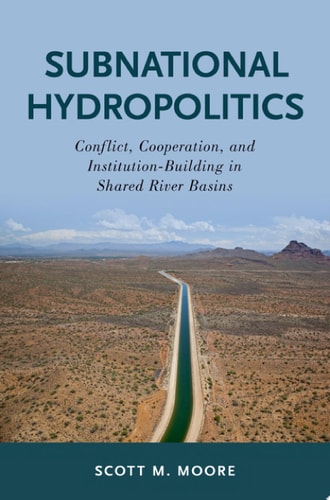
Subnational Hydropolitics: Conflict, Cooperation, and Institution-Building in Shared River Basins
0
0
As an Amazon Associate and affiliate partner, Menrva Books earns from qualifying purchases. Learn more
Author Description
The prospect of international conflict over water has long been the subject of academic and popular concern, but subnational political conflict is considerably more common, and almost certainly imposes greater economic and environmental costs. Indeed, subnational hydropolitics are an important feature of several large countries, including the United States, India, and China. Moreover, disputes between water users in shared river basins have often persisted despite repeated attempts by central governments to resolve them through both persuasion and coercion. Yet despite the growing threat of water scarcity around the world, little research exists on sub-national politics of shared water resources. This book attempts to fill the gap by explaining how and why hydropolitics play out within countries, as well as between them. Subnational Hydropolitics re-examines the issue of water conflict by examining conflicts at the subnational rather than international level. By examining several in-depth case studies of both conflict and cooperation, Scott Moore argues that increasing sub-national water conflict is driven by two inter-linked forces, identity politics, which gives subnational politicians a reason to compete over shared water resources; and political decentralization, which provides them with the tools to do so. To understand politics at the subnational level, the book blends insights from both the environmental governance and comparative politics literatures. By examining the challenges many countries face in achieving cooperation over shared water resources, the book helps to shed light on different mechanisms and processes for solving cooperation problems at the regional scale lessons relevant to tackling a wide range of transboundary environmental problems, including air pollution, urbanization, and ecosystem protection. But at its core, this book promises a definitive contribution to the growing sub-field of environmental politics, centered on understanding how
Menrva's Summary
THE THESIS
This book investigates the drivers of subnational water conflict and the mechanisms for achieving cooperation within shared river basins. Scott M. Moore, an expert in environmental governance, utilizes a comparative political framework to analyze why disputes between water users persist despite central government intervention. By synthesizing data from multiple national contexts, the author argues that the intersection of identity politics and political decentralization creates unique incentives for regional competition over water resources.
THE SCOPE MAP
What You Will Find
- Comparative analysis of water governance in the United States, India, and China
- Theoretical framework linking identity politics to resource competition
- In-depth case studies of both conflict and cooperative outcomes
- Application of environmental governance and comparative politics theories
Scope Limits
- Does not focus on international or transboundary water conflicts between sovereign nations
- Does not provide technical hydrological or engineering solutions for water scarcity
THE AUTHORITY PERSPECTIVE
Experts identify this work as a significant contribution to the sub-field of environmental politics by shifting the analytical focus from the international to the subnational level. Readers frequently note the academic rigor and the clarity with which the author connects political decentralization to environmental management challenges.
Page Count:
288
Publication Date:
2018-01-01
Publisher:
Oxford University Press
ISBN-10:
0190864117
ISBN-13:
9780190864118
Governance
Hydropolitics
Water Rights
Nature
Public Administration
Public Policy
International relations
Water Supply
Community Tags
Similar Books