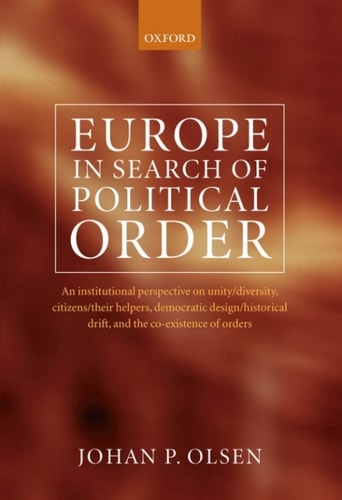
Europe in Search of Political Order: An Institutional Perspective on Unity/Diversity, Citizens/Their Helpers, Democratic Design/Historical Drift and the Co-existence of Orders
0
0
As an Amazon Associate and affiliate partner, Menrva Books earns from qualifying purchases. Learn more
Author Description
This book deals with ongoing processes of European cooperation and integration, processes that may have a potential to change the political organization of Europe. Based on ideas from 'the new institutionalism' the book offers a systematic perspective on institutional change and in particular the role of institutions in relation to four central and durable issues in the study of political life. These are: (1) the mediation between unity and diversity: what ties a society together and what keeps it apart. (2) The relations between citizens and their helpers: why the democratic deficit in the European Union can not be eliminated solely by making mechanisms of direct citizens participation and representation more efficient. Needed are also institutions that make direct participation redundant because they routinely work with integrity, generating expected and desired outcomes. (3) The relation between democratic design and historical drift: To what degree democracies are able to design and reform key institutions of governance so that their structures reflect popular will, understanding and control. (4) The co-existence of old and new political orders: How elements of a new order may supplement rather than replace elements of the old order, generating a 'mixed order' based on partly inconsistent principles and rules.
Menrva's Summary
THE THESIS
This book investigates how the institutional architecture of Europe shapes the ongoing processes of integration and the resulting political order. Johan P. Olsen, a prominent scholar in organizational theory and political science, utilizes the framework of 'new institutionalism' to analyze the dynamics of European cooperation. He argues that the political organization of Europe is not merely a product of design but a complex interaction between historical drift and intentional reform, challenging conventional views on democratic legitimacy and institutional stability.
THE SCOPE MAP
What You Will Find
- A theoretical application of new institutionalism to European integration.
- An analysis of the tension between unity and diversity in supranational governance.
- A critique of the democratic deficit and the role of institutional integrity.
- A study of the coexistence of overlapping political orders.
Scope Limits
- The text does not provide a comprehensive historical narrative of the European Union.
- It does not offer specific policy prescriptions for current legislative challenges.
THE AUTHORITY PERSPECTIVE
Scholars in the field of European studies frequently cite this work as a foundational text for understanding the structural complexities of the European Union. Readers often note the high level of academic density and the sophisticated theoretical rigor applied throughout the analysis.
Page Count:
340
Publication Date:
2007-01-01
Publisher:
Oxford University Press
ISBN-10:
0191526800
ISBN-13:
9780191526800
Political Theory
Governance
International relations
European Union
Community Tags
Similar Books