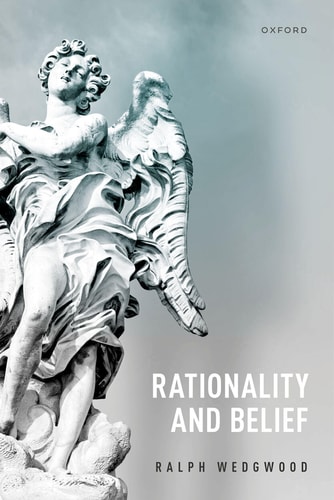
Rationality and Belief
0
0
As an Amazon Associate and affiliate partner, Menrva Books earns from qualifying purchases. Learn more
Author Description
This book gives a general theory of rational belief. Although it can be read by itself, is a sequel to the author's previous book The Value of Rationality (Oxford, 2017). It takes the general conception of rationality that was defended in that earlier book, and combines it with an account of the varieties of belief, and of what it is for these beliefs to count as “correct”, to develop an account of what it is for beliefs to count as rational. According to this account, rationality comes in degrees: the degree to which one's beliefs counts as rational is determined by their distance from a corresponding probability function - where this distance is measured by those beliefs' “expected degree of incorrectness” according to the probability function; the account also involves an explanation of what determines exactly which probability function plays this role in each case, and of why this probability function should play this role.In developing and defending this account, new light is shed on several central epistemological issues. These issues include: the distinction between propositional and doxastic justification; the debates between internalism and externalism, and between foundationalism and coherentism; the significance - or lack of it - of the notion of 'evidence'; the relationship between credences, full belief, inference, and suspension of judgment; the nature of the kind of possibility that is presupposed by the relevant sort of probability; and whether rationality is “diachronic” - so that the beliefs that it is rational for us to have now depend, in part, on the beliefs that we held in the past. Finally, some suggestions are made about how this theory bears on a range of further topics, including the defeasibility of inference, scepticism, and the analysis of knowledge.
Menrva's Summary
THE THESIS
This book investigates the nature of rational belief by proposing a general theory that defines rationality in terms of degrees of belief and their distance from a probability function. Ralph Wedgwood, a prominent philosopher, builds upon his previous work to construct a framework that explains how beliefs are evaluated for correctness. By measuring the 'expected degree of incorrectness' of beliefs, the author provides a formal account of what constitutes rational thought. The text serves as a rigorous exploration of how probability functions determine the rationality of an individual's cognitive states.
THE SCOPE MAP
What You Will Find
- A formal theory of rational belief based on probability functions and expected incorrectness.
- An analysis of the relationship between credences, full belief, inference, and suspension of judgment.
- A critical examination of epistemological debates including internalism versus externalism and foundationalism versus coherentism.
- Discussions on the nature of diachronic rationality and the role of evidence in justification.
THE AUTHORITY PERSPECTIVE
Experts in epistemology recognize this work as a significant contribution to the formal study of rational belief. Readers frequently note the technical density of the prose, which requires a strong background in analytic philosophy to fully grasp the author's arguments.
Page Count:
336
Publication Date:
2023-09-02
Publisher:
Oxford University Press
ISBN-10:
0198874499
ISBN-13:
9780198874492
Philosophy
Non-Fiction
Epistemology
Knowledge Theory
Logic
Community Tags
Other Editions(2)

Similar Books