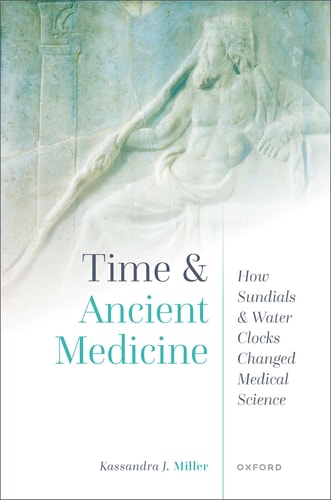
Time and Ancient Medicine: How Sundials and Water Clocks Changed Medical Science
0
0
As an Amazon Associate and affiliate partner, Menrva Books earns from qualifying purchases. Learn more
Author Description
Time and Ancient Medicine is the first monograph to explore, on the one hand, how the introduction of new timekeeping technologies (namely, sundials and water clocks) affected the practice, rhetoric, and philosophy of ancient medicine and, on the other hand, how medical timekeeping practices affected engagement with time elsewhere in society. The study seeks, first, to offer a chronological narrative of how timekeeping technologies and medical practices evolved and influenced one another in ancient Greece and Rome, with consideration of relevant Pharaonic Egyptian and Assyro-Babylonian precedents. Kassandra J. Miller turns to a series of case studies, drawn from the Roman Imperial period, to investigate thematic questions, asking how debates over medical timekeeping interacted with debates over proper scientific methodology, the status of medicine as a formal art, and the relationships between medicine and other disciplines like mathematics, astronomy, and astrology. Throughout, this study places epigraphic, artistic, and other material evidence for hourly timekeeping in dialogue with selections from medical literature, some of which has not previously been published in modern-language translation. Ultimately, this study reveals that time and timekeeping played fundamental roles in ancient medical debates and practices and challenges the traditional narrative that the social history of “clock time” only begins with the invention of the mechanical clock in the Medieval period. It offers new insights into the specific ways that physicians of the ancient Mediterranean engaged with their evolving temporal landscapes and raises questions about the relationships between time and medicine in the modern day.
Menrva's Summary
THE THESIS
This monograph investigates how the adoption of sundials and water clocks in the ancient Mediterranean fundamentally reshaped medical practice, rhetoric, and the broader societal understanding of time. Prof. Kassandra J. Miller utilizes a combination of medical literature, epigraphic records, and artistic evidence to argue that ancient physicians were active participants in a sophisticated temporal culture long before the advent of mechanical clocks. By examining the Roman Imperial period, the author demonstrates that medical timekeeping was deeply intertwined with contemporary debates regarding scientific methodology and the professional status of medicine as an art form.
THE SCOPE MAP
What You Will Find
- A chronological analysis of timekeeping technology evolution in ancient Greece, Rome, Egypt, and Mesopotamia.
- Case studies focusing on the intersection of medical practice and temporal precision during the Roman Imperial era.
- An examination of the relationship between medicine and auxiliary disciplines such as mathematics, astronomy, and astrology.
- Analysis of previously untranslated medical texts alongside material evidence of hourly timekeeping.
THE AUTHORITY PERSPECTIVE
Experts recognize this work as a significant contribution to the history of science, specifically for its challenge to the traditional timeline of clock-based social history. Readers frequently note the academic density of the prose and the author's meticulous integration of diverse primary source materials.
Page Count:
256
Publication Date:
2023-01-01
Publisher:
Oxford University Press
ISBN-10:
0198885172
ISBN-13:
9780198885177
Science
History
Philosophy
Technology
History - Ancient
Science
Ancient History
Medicine
Community Tags
Similar Books














