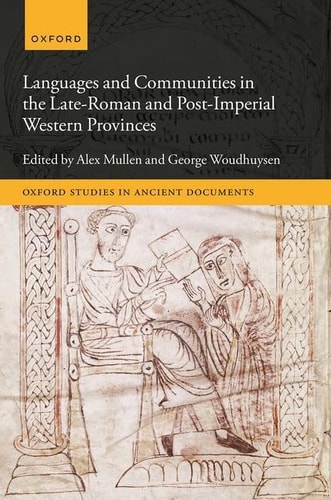
Languages and Communities in the Late and Post-Roman Western Provinces
0
0
As an Amazon Associate and affiliate partner, Menrva Books earns from qualifying purchases. Learn more
Author Description
This is an open access title available under the terms of a CC BY-NC-ND 4.0 International licence. It is free to read on Oxford Academic and offered as a free PDF download from OUP and selected open access locations.Languages are central to the creation and expression of identities and cultures, as well as to life itself, yet the linguistic variegation of the later-Roman and post-imperial period in the Roman west is remarkably understudied. A deeper understanding of this important issue is crucial to any reconstruction of the broader story of linguistic continuity and change in Europe and the Mediterranean, as well as to the history of the communities who wrote, read, and spoke Latin and other languages. Languages and Communities in the Late-Roman and Post-Imperial Western Provinces offers the first comprehensive modern study of the main developments, key features and debates of the later-Roman and post-imperial linguistic environment, focusing on the Iberian Peninsula, North Africa, Gaul, the Germanies, Britain and Ireland. The chapters collected in this volume help us to understand better the embeddedness, or not, of Latin, at different social levels and across provinces, to consider (socio)linguistic variegation, bi-/multi-lingualism, and attitudes towards languages, and to confront the complex role of language in the communities, identities, and cultures of the later- and post-imperial Roman western world.This volume will be accompanied by two further volumes from the European Research Council-funded LatinNow project: Social Factors in the Latinization of the Roman West and Latinization, Local Languages, and Literacies in the Roman West.
Menrva's Summary
THE THESIS
This volume investigates the complex interplay between linguistic evolution and social identity within the Western provinces during the transition from the late Roman period to the post-imperial era. Editors Alex Mullen and George Woudhuysen curate a collection of scholarly contributions that examine how Latin functioned alongside local languages across diverse geographic regions. By analyzing epigraphic evidence and historical records, the authors argue that linguistic continuity and change were fundamental to the formation of post-Roman cultural identities.
THE SCOPE MAP
What You Will Find
- Regional linguistic analysis covering the Iberian Peninsula, North Africa, Gaul, the Germanies, Britain, and Ireland.
- Examination of sociolinguistic variegation and the prevalence of bi
- and multi-lingualism in late antiquity.
- Assessment of the social embeddedness of Latin across different strata of provincial society.
- Exploration of attitudes toward language use and its role in defining community and cultural boundaries.
THE AUTHORITY PERSPECTIVE
Experts recognize this work as a significant contribution to the field of Roman studies, particularly for its focus on understudied linguistic developments. Readers frequently note the academic density of the prose, which serves as a foundational resource for researchers examining the transition from the Roman world to the early Middle Ages.
Page Count:
368
Publication Date:
2024-01-01
Publisher:
Oxford University Press
ISBN-10:
0198888953
ISBN-13:
9780198888956
History
Roman Empire
Educational Resources
Ancient History
European History
Words Language & Grammar
Linguistics
Reference
Community Tags
Similar Books