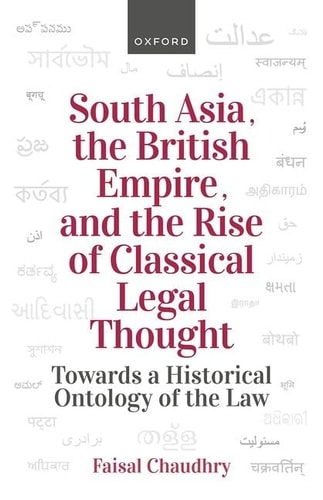
South Asia, the British Empire, and the Rise of Classical Legal Thought: Toward a Historical Ontology of the Law
0
0
As an Amazon Associate and affiliate partner, Menrva Books earns from qualifying purchases. Learn more
Author Description
This book delves into the legal history of colonial governance in South Asia, spanning the period from 1757 to the early 20th century. It traces a notable shift in the way sovereignty, land control, and legal rectification were conceptualized, particularly after 1858. During the early phase of the rule of the East India Company, the focus was on 'the laws' that influenced the administration of justice rather than 'the law' as a comprehensive normative system. The Company's perspective emphasized absolute property rights, particularly concerning land rent, rather than physical control over land. This viewpoint was expressed through the obligation of revenue payment, with property existing somewhat outside the realm of law. This early colonial South Asian legal framework differed significantly from the Anglo-common law tradition, which had already developed a unified and physical concept of property rights as a distinct legal form by the late 18th century. It was only after the transfer of authority from the Company to the British Crown, along with other shifts in the imperial political economy, that the conditions were ripe for 'the law' to emerge as an autonomous and fundamental institutional concept. One of the contributing factors to this transformation was the emergence of classical legal thought. Under Crown rule, two distinct forms of discourse contributed to reshaping the legal ontology around the globalized notion of 'the law' as an independent concept. The book, adopting a historical approach to jurisprudence, categorizes these forms as doctrinal discourse, which could articulate propositions of the law with practical and administrative qualities, and ordinary language discourse, which conveyed ideas about the law, including in the public domain.
Menrva's Summary
THE THESIS
This book investigates the historical transformation of legal thought in colonial South Asia, specifically examining how the transition from East India Company rule to the British Crown facilitated the emergence of 'the law' as an autonomous, fundamental institutional concept. Faisal Chaudhry, a scholar of legal history, utilizes archival research and jurisprudential analysis to contrast the early colonial focus on administrative revenue systems with the later adoption of classical legal thought. By mapping the shift from fragmented 'laws' to a unified, globalized legal ontology, the author provides a framework for understanding how imperial political economy reshaped the conceptualization of sovereignty and property rights.
THE SCOPE MAP
What You Will Find
- Historical analysis of colonial governance in South Asia from 1757 to the early 20th century.
- A comparative study between East India Company administrative practices and the subsequent Anglo-common law tradition.
- Examination of the role of doctrinal discourse and ordinary language discourse in shaping legal ontology.
- Analysis of the transition in property rights conceptualization from revenue-based obligations to physical, unified legal forms.
THE AUTHORITY PERSPECTIVE
Experts in legal history and South Asian studies identify this work as a significant contribution to the understanding of colonial jurisprudence and the evolution of modern legal systems. Readers frequently note the academic density of the prose, which provides a rigorous examination of the intersection between imperial political economy and the development of classical legal thought.
Page Count:
560
Publication Date:
2024-11-16
Publisher:
Oxford University Press
ISBN-10:
0198916485
ISBN-13:
9780198916482
History
Politics
Specific Topics
Educational Resources
Legal History
Jurisprudence
Colonialism
South Asia
Community Tags
Similar Books