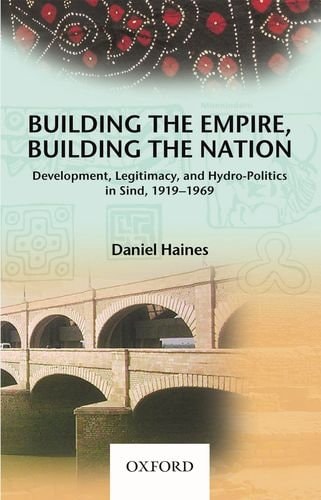
Building the Empire, Building the Nation: Development, Legitimacy, and Hydro-Politics in Sind, 1919-1969
0
0
As an Amazon Associate and affiliate partner, Menrva Books earns from qualifying purchases. Learn more
Author Description
European empires disintegrated during the twentieth century, leaving newly-formed postcolonial states in their wake. In this turbulent period, governments sought new political idioms to support their claims to legitimacy as modern states. In Sindh, a part of British India and (later) of Pakistan, the late colonial and early post-colonial states combined major attempts to control the natural environment with a serious engagement with representative politics in their bid for legitimacy. The construction of three barrage dams across the River Indus, along with a network of irrigation canals, enacted human control over nature as a political project; while the complicated relationship between bureaucracies and legislatures moved towards a democratic ideal after the First World War.This book examines tensions between representative and developmental sources of state legitimacy. It argues that the democratic trend of constitutional changes during the middle of the century conflicted with the authoritarian economic imperatives of the barrage projects, which Sindh's rulers believed to be necessary for the projects' successful execution. The barrage projects were based on the concept, endorsed by British officials and their Pakistani successors, that material progress would bring prosperity and happiness to Sindh. Both the colonial and post-colonial governments capitalized on the projects' rhetorical potential, creating a discourse in which the modern state's unique ability to mobilize scientific expertise in the public good justified its rule.This book argues that the late colonial and early postcolonial states had a great deal in common. It demonstrates this contention by highlighting similarities between the actions and rhetoric of governments before and after Partition in building and managing the barrage projects. The changing relationships between rulers, politicians and rural magnates between the 1920s and 1960s were intertwined with the rising idea that the state was
Menrva's Summary
THE THESIS
This work investigates how the late colonial and early postcolonial states in Sindh utilized large-scale hydraulic engineering projects to establish political legitimacy and assert authority. Daniel Haines, a scholar of South Asian history and environmental politics, utilizes archival records and administrative history to analyze the intersection of irrigation development and constitutional governance. He argues that the authoritarian imperatives required to manage massive barrage projects frequently clashed with the emerging democratic ideals of the mid-twentieth century, revealing a surprising continuity in statecraft across the 1947 Partition.
THE SCOPE MAP
What You Will Find
- A detailed historical analysis of the construction of three major barrage dams on the River Indus between 1919 and 1969.
- An examination of the shifting power dynamics between colonial bureaucrats, post-independence Pakistani officials, and rural land-owning magnates.
- A study of the rhetorical strategies used by the state to equate scientific and material progress with moral and political authority.
- An assessment of the tension between representative legislative processes and the top-down management of natural resources.
THE AUTHORITY PERSPECTIVE
Historians and political scientists recognize this text as a significant contribution to the study of environmental governance and state-building in South Asia. Scholars frequently highlight the author's ability to bridge the divide between colonial and postcolonial historiography through the lens of hydro-politics.
Page Count:
250
Publication Date:
2014-01-01
Publisher:
Oxford University Press
ISBN-10:
0199068488
ISBN-13:
9780199068487
History
Environmental History
Water Supply
Community Tags
Similar Books