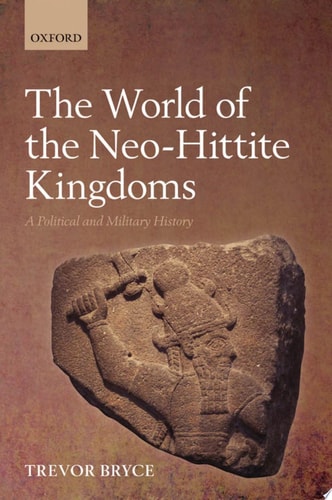
The World of Neo-Hittite Kingdoms: A Political and Military History
0
0
As an Amazon Associate and affiliate partner, Menrva Books earns from qualifying purchases. Learn more
Author Description
In the early 12th century, the Late Bronze Age Hittite empire collapsed during a series of upheavals which swept the Greek and Near Eastern worlds. In the subsequent Iron Age, numerous cities and states emerged in south-eastern Anatolia and northern Syria, which are generally known today as the "Neo-Hittite kingdoms." Bryce's volume gives an account of the military and political history of these kingdoms, moving beyond the Neo-Hittites themselves to the broader Near Eastern world and the states which dominated it during the Iron Age.Divided into three sections, The World of Neo-Hittite Kingdoms looks at the last decades of the empire and the features of these kingdoms and their subsequent treatment under their Anatolian successors. Through a closer look at the individual Neo-Hittite kingdoms and their rulers and a comparison with the contemporary Aramaean states and the other kingdoms of the age--notably the Neo-Assyrian empire --it concludes with a historical synthesis of the Neo-Hittites when the last kingdom was absorbed into the Assyrian provincial administration.
Menrva's Summary
THE THESIS
This volume investigates the political and military evolution of the Neo-Hittite kingdoms that emerged in the power vacuum following the collapse of the Late Bronze Age Hittite Empire. Trevor Bryce, a recognized scholar in Hittite studies, utilizes archaeological evidence and historical records to reconstruct the trajectory of these Iron Age states. The work provides a systematic framework for understanding how these kingdoms functioned, interacted with neighboring powers, and were eventually integrated into the Neo-Assyrian provincial system.
THE SCOPE MAP
What You Will Find
- A detailed analysis of the transition from the Late Bronze Age to the Iron Age in Anatolia and Syria.
- Comparative studies between Neo-Hittite kingdoms and contemporary Aramaean states.
- Examination of the geopolitical influence exerted by the Neo-Assyrian Empire.
- A chronological synthesis of individual kingdoms, their rulers, and their eventual administrative absorption.
THE AUTHORITY PERSPECTIVE
Scholars and students of Near Eastern history frequently cite this work as a comprehensive reference for the post-Hittite period. The text is noted for its clear synthesis of complex political developments and its utility as a foundational resource for understanding Iron Age Anatolian history.
Page Count:
320
Publication Date:
2012-04-07
Publisher:
Oxford University Press
ISBN-10:
0199218722
ISBN-13:
9780199218721
History
Politics & Government
Ancient History
Military History
Political History
Syria history
Turkey history
Archaeology
Community Tags
Similar Books