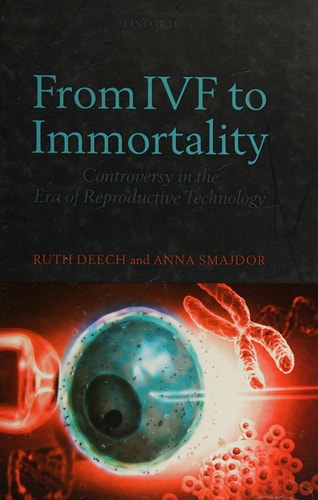
From IVF to Immortality: Controversy in the Era of Reproductive Technology
0
0
As an Amazon Associate and affiliate partner, Menrva Books earns from qualifying purchases. Learn more
Author Description
This is a book for anyone who has ever paused to wonder whether cloning will ever be legal. Why it is that "savior siblings" and sex selection provoke such strong reactions? Will there ever be such a thing as an artificial womb?Assisted reproductive technologies are unique in their capacity to challenge our assumptions and elicit passionate responses. Looking at the moral, philosophical, and legal issues surrounding cases of surrogacy, single or same-sex parenthood, retrieval of sperm from dead or dying patients, and the impregnation of post-menopausal women, this book questions whether these rapidly-developing technologies are refashioning the nature of the family.The US and UK have played unique roles in the development and regulation of reproductive technologies, and has been at the forefront of controversy over "savior siblings", designer babies, reproductive cloning, and embryo research. This book provides a clear and simple account of the techniques involved in assisted reproduction and embryo research, and discusses the legal and ethical implications of some of these technologies, illustrated by compelling descriptions of real-life cases. The book also addresses the ways in which reproductive technologies are regulated, critically examining the role of the Human Fertilization and Embryology Authority and comparing the UK's approach with that of other countries. Finally, it contemplates the possibility that some of our most deeply-held assumptions about human nature may be called into question by further developments in stem cell research and fertility treatments.
Menrva's Summary
THE THESIS
This book investigates the ethical, legal, and social implications of rapidly advancing reproductive technologies and their potential to redefine the nature of the human family. Anna Smajdor and Ruth Deech utilize their expertise in bioethics and law to analyze the regulatory frameworks governing assisted reproduction. By examining the tension between technological capability and moral tradition, the authors argue that current policies must evolve to address the profound questions raised by practices such as surrogacy, embryo research, and genetic selection.
THE SCOPE MAP
What You Will Find
- Comparative analysis of reproductive technology regulation in the US and the UK.
- Ethical examinations of controversial practices including savior siblings, sex selection, and post-menopausal pregnancy.
- Case studies detailing the legal challenges surrounding sperm retrieval and surrogacy.
- Technical explanations of assisted reproductive techniques and the role of the Human Fertilization and Embryology Authority.
THE AUTHORITY PERSPECTIVE
Experts identify this work as a balanced and accessible primer for those navigating the complex intersection of law and bioethics. Readers frequently note that the authors successfully distill dense regulatory information into clear, thought-provoking arguments suitable for both students and the general public.
Page Count:
248
Publication Date:
2008-01-06
Publisher:
Oxford University Press
ISBN-10:
0199219796
ISBN-13:
9780199219797
Science
Reproductive Technology
Law
Technology
Ethics
Sociology
Medicine
Cloning
Community Tags
Similar Books