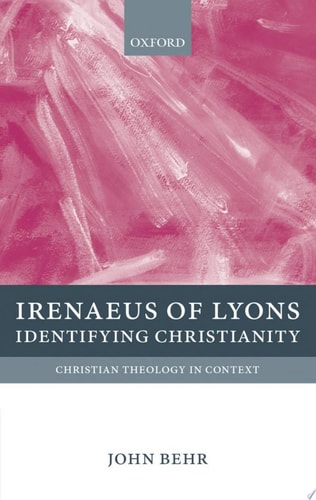
Irenaeus of Lyons: Identifying Christianity
0
0
As an Amazon Associate and affiliate partner, Menrva Books earns from qualifying purchases. Learn more
Author Description
This book provides a full, contextual study of St Irenaeus of Lyons, the first great theologian of the Christian tradition. John Behr sets Irenaeus both within his own context of the second century, a fundamental period for the formation of Christian identity, elaborating the distinction between orthodoxy and heresy and expounding a comprehensive theological vision, and also within our own contemporary context, in which these issues are very much alive again. Against the commonly-held position that 'orthodoxy' was established by excluding others, the 'heretics', Behr argues that it was the self-chosen separation of the heretics that provided the occasion for those who remained together to clarify the lineaments of their faith in a church that was catholic by virtue of embracing different voices in a symphony of many voices and whose chief architect was Irenaeus, who, as befits his name, urged peace and toleration.The first chapter explores Irenaeus' background in Asia Minor, as a disciple of Polycarp of Smyrna, his activity in Gaul, and his involvement with the Christian communities in Rome. The theological and institutional significance of his interventions is made clear by tracing the coalescence of the initially fractionated communities in Rome into a united body over the first two centuries.The second chapter provides a full examination of Irenaeus' surviving writings, concentrating especially on the literary and rhetorical structure of his five books Against the Heresies, his 'refutation and overthrowal' of his opponents in the first two books, and his establishing a framework for articulating orthodoxy.The final chapter explores the theological vision of Irenaeus itself, on its own terms rather than the categories of later dogmatic theology, grounded in an apostolic reading of Scripture and presenting a vibrant and vigorous account of the diachronic and synchronic economy or plan of God, seen through the work of Christ which reveals how the Hands of God have been at work from the beginning, fashioning the creature, made from mud and animated with a breath of life, into his own image and likeness, vivified by the Holy Spirit, to become a 'living human being, the glory of God'.
Menrva's Summary
THE THESIS
This book investigates how Irenaeus of Lyons shaped early Christian identity by navigating the tensions between emerging orthodoxy and competing theological movements. John Behr, a prominent scholar of patristics, utilizes historical analysis and textual criticism to re-examine Irenaeus's role in the second century. He argues against the narrative that orthodoxy was defined solely through exclusion, proposing instead that Irenaeus fostered a catholic unity that embraced diverse voices. By situating Irenaeus within his specific historical context, Behr provides a framework for understanding how early Christian doctrine was articulated and institutionalized.
THE SCOPE MAP
What You Will Find
- Historical analysis of Irenaeus's background in Asia Minor and his influence in Gaul and Rome.
- A detailed examination of the literary and rhetorical structure of the five books of Against the Heresies.
- An exploration of Irenaeus's theological vision grounded in an apostolic reading of Scripture.
- A study of the development of institutional unity within early Christian communities.
THE AUTHORITY PERSPECTIVE
Scholars and students of patristics frequently cite this work as a critical re-evaluation of Irenaeus's contribution to early church history. Readers often note the academic density of the prose, which provides a rigorous and nuanced perspective on the formation of Christian identity.
Page Count:
236
Publication Date:
2013-09-15
Publisher:
Oxford University Press
ISBN-10:
019921462X
ISBN-13:
9780199214624
Biography
Philosophy
Religion
Church History
Christian Theology
Bible theology
Community Tags
Other Editions(2)
Similar Books



Reader Comments
Share Your Thoughts
No comments yet. Be the first to share your thoughts!