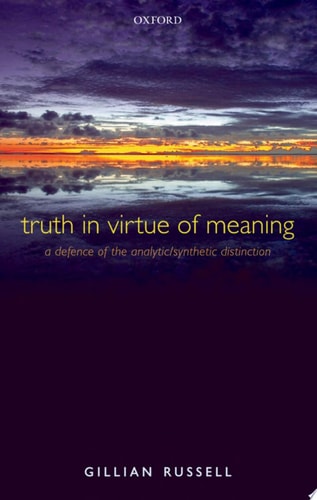
Truth in Virtue of Meaning: A Defence of the Analytic/Synthetic Distinction
0
0
As an Amazon Associate and affiliate partner, Menrva Books earns from qualifying purchases. Learn more
Author Description
The analytic/synthetic distinction looks simple. It is a distinction between two different kinds of sentence. Synthetic sentences are true in part because of the way the world is, and in part because of what they mean. Analytic sentences--like all bachelors are unmarried and triangles have three sides--are different. They are true in virtue of meaning, so no matter what the world is like, as long as the sentence means what it does, it will be true.This distinction seems powerful because analytic sentences seem to be knowable in a special way. One can know that all bachelors are unmarried, for example, just by thinking about what it means. But many twentieth-century philosophers, with Quine in the lead, argued that there were no analytic sentences, that the idea of analyticity didn't even make sense, and that the analytic/synthetic distinction was therefore an illusion. Others couldn't see how there could fail to be a distinction, however ingenious the arguments of Quine and his supporters.But since the heyday of the debate, things have changed in the philosophy of language. Tools have been refined, confusions cleared up, and most significantly, many philosophers now accept a view of language--semantic externalism--on which it is possible to see how the distinction could fail. One might be tempted to think that ultimately the distinction has fallen for reasons other than those proposed in the original debate.In Truth in Virtue of Meaning, Gillian Russell argues that it hasn't. Using the tools of contemporary philosophy of language, she outlines a view of analytic sentences which is compatible with semantic externalism and defends that view against the old Quinean arguments. She then goes on to draw out the surprising epistemological consequences of her approach.
Menrva's Summary
THE THESIS
Can the analytic/synthetic distinction be defended against the critiques of Quine and the implications of semantic externalism? Professor Gillian K. Russell examines the historical and contemporary challenges to the distinction between analytic and synthetic sentences. By utilizing modern tools in the philosophy of language, she constructs a robust defense of analyticity that remains compatible with semantic externalism. The work systematically addresses classic objections while exploring the epistemological ramifications of maintaining this distinction in contemporary discourse.
THE SCOPE MAP
What You Will Find
- A rigorous analysis of the analytic/synthetic distinction within the context of twentieth-century philosophy.
- A critical evaluation of Quinean arguments against the existence of analytic sentences.
- A theoretical framework reconciling analyticity with semantic externalism.
- An investigation into the epistemological consequences of defining truth in virtue of meaning.
THE AUTHORITY PERSPECTIVE
Experts recognize this work as a significant contribution to the philosophy of language, particularly for its attempt to rehabilitate a concept long considered problematic by many scholars. Readers frequently note the technical density of the prose, which is intended for an audience familiar with formal logic and analytic philosophy.
Page Count:
256
Publication Date:
2008-05-07
Publisher:
Oxford University Press
ISBN-10:
0199232199
ISBN-13:
9780199232192
Philosophy
Truth
Epistemology
Logic
Knowledge Theory
Metaphysics
Community Tags
Similar Books