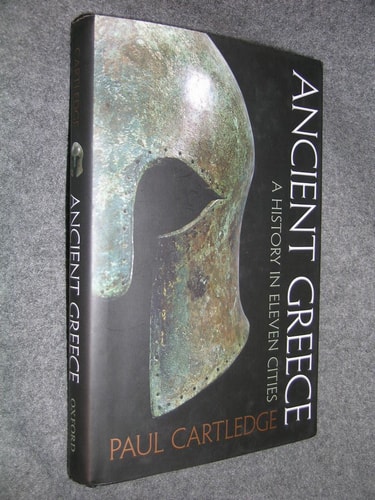
Ancient Greece: A History in Eleven Cities
0
0
As an Amazon Associate and affiliate partner, Menrva Books earns from qualifying purchases. Learn more
Author Description
The contribution of the ancient Greeks to modern western culture is incalculable. In the worlds of art, architecture, myth, literature, and philosophy, the world we live in would be unrecognizable without the formative influence of ancient Greek models.This highly original and stimulating introduction to ancient Greece takes the city as its starting point, revealing just how central the polis ("city-state" or "citizen-state") was to Hellenistic cultural achievements. In particular, Paul Cartledge uses the history of eleven major Greek cities--out of more than a thousand--to illuminate the most important and informative aspects of Greek history. The book spans a surprisingly long time period, ranging from the first examples of ancient Greek language from Cnossus in Crete around 1400 BC to the establishment of Constantinople (today's Istanbul) in 324 AD on the site of the Greek city of Byzantion. Cartledge highlights the role of such renowned cities as Athens (birthplace of democracy) and Sparta, but he also examines Argos, Thebes, Syracuse in Sicily, and Alexandria in Egypt, as well as lesser known locales such as Miletus (home of the West's first intellectual, Thales) and Massalia (Marseilles today), where the Greeks introduced the wine grape to the French. The author uses these cities to illuminate major themes, from economics, religion, and social relations, to gender and sexuality, slavery and freedom, and politics. And throughout, the book explores how these eleven cities differed both from each other and from modern society.An innovative approach to ancient Greece and its legacy, both in terms of the time span covered and in its unique city-by-city organization, this superb volume provides the ideal concise introduction to the history and culture of this remarkable civilization.
Menrva's Summary
THE THESIS
How did the structure of the individual city-state, or polis, define the trajectory and cultural output of ancient Greek civilization? Paul Cartledge, a distinguished scholar of Greek history, utilizes a comparative framework to analyze the development of Hellenic society. By focusing on eleven distinct urban centers, he argues that the diversity of these city-states—ranging from political powerhouses to colonial outposts—provides a more accurate understanding of Greek history than a singular, monolithic narrative. The text synthesizes archaeological evidence and historical records to demonstrate how local governance and social norms shaped the broader Mediterranean world.
THE SCOPE MAP
What You Will Find
- A chronological survey spanning from 1400 BC at Cnossus to the founding of Constantinople in 324 AD.
- A comparative analysis of eleven specific cities, including Athens, Sparta, Thebes, Syracuse, and Alexandria.
- Examination of thematic pillars such as democracy, slavery, gender roles, and economic trade.
- An exploration of the cultural diffusion of Greek influence across the Mediterranean and into modern Western society.
THE AUTHORITY PERSPECTIVE
Scholars and students frequently cite this work as a highly accessible entry point for understanding the complexities of the Greek polis. Experts note that Cartledge’s city-by-city methodology effectively simplifies dense historical periods into manageable, thematic case studies.
Page Count:
261
Publication Date:
2010-02-13
Publisher:
Oxford University Press
ISBN-10:
0199233381
ISBN-13:
9780199233380
History
Ancient History
Greece
Community Tags
Similar Books